|
|
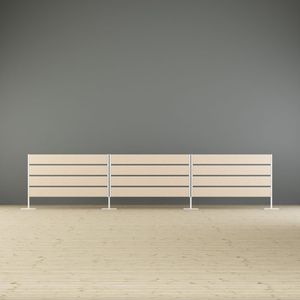
Ant-noise baffles made in the Royal Building System constitute a perfect way to minimize a harmful influence on human health caused by (road and railway) traffic noises and industrial noises
A simple assembly is based on connection of profiled construction elements made of high impact-resistant polymers being a shell for sound absorbing material or concrete shuttering.
The RBS is a technology of building optimal for this kind of application. Its highest virtue is easy and fast assembly, no need to provide maintenance, and beautiful appearance for many years
Advantages of anti-noise baffles made of RBS:
- remarkable acoustic efficiency
- easy and fast assembly
- possibility of making baffles with plants growing
- excellent durability and beautiful appearance of the object erected
- no need to provide maintenance for many years.
|
|
|
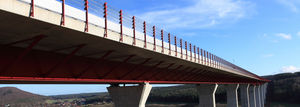
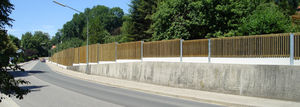
This material with integrated polyamide filaments is used particularly in settings where exposed places exist in the sense of specification ZTVLsw 88. The integrated guard rail ensures a maximum of safety. Of course, Kohlhauer offers approved accessories, such as stainless steel ropes, EPDM seals for soundproof fastening at bases and bridge fenders as well as posts.
|
|
|
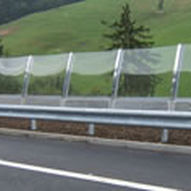
This highly-transparent sound insulation wall made of acrylic glass excels through excellent optical properties, longevity and resistance to atmospheric corrosion (10 years warranty) as well as best sound control properties. Because of its variable formats and thicknesses, its availability in various colours and special designs, KOHLHAUER® Clearview provides a lot of scope for creative opportunities, e.g. in combination with wooden sound protection elements of type Beck BL 99a and variants.
|
|
|
|
|
|
Wood Preservation
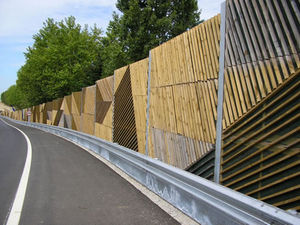
Wood can be well preserved by profiling its cross-sections in an appropriate manner. Chemical preservation of wood is possible using boiler-pressured impregnation in accord with DIN 68 800, or optionally with CKB salt (containing chrome) or CX salt (chrome-free). The colour tone is green. Other colouring is possible on a limited basis. The impregnation is resistant to salt used for melting purposes and is not impaired by plants. Wooden barriers are especially well suited for supporting climbing plants.
Design
Profiled, horizontal wood railings above and below. Vertically arranged tongue and groove planking (30 mm) is nailed from the reverse side of the wall to this framing. Exterior to the planking and including a 60 mm hollow space, an absorption plate with a conduit density of > 1000 N/cbm is attached and concealed on the front side with black fibre glass batting. The barrier surface which is to be impacted by noise is covered with poles that have been flattened and nailed vertically (flattened diameter 54 mm x 40 mm, separated at the core and milled). Vertical wooden filling elements are assembled to the pole connections and are milled in order to incorporate compression sealing tape. The wall is additionally stabilized on the reverse side with wedges.
|
|
Solar energy advantage with noise protective walls
The integration of photovoltaic in existing or planned noise protection walls represents a new challenge. They offer the double uses of noise protection in conjunction with ecologically compatible generation of energy. In order to devise the most technically up-to-date solutions, Kohlhauer here works in close co-operation with experienced partners from the photovoltaic industry and business. Among others, items have been successfully achieved jointly in Freising and in Zürich.
|
|
|
This plantable sound insulation wall made of rock wool with unique, environmentally friendly properties has to be built both in an intensive and extensive design. It features excellent sound-dampening and highlyabsorbing properties on both sides with little space required and quick assembly.
|
|
Highly transparent noise protection panels Soundgard TOP®
The highly transparent sound protection sheets named Soundgard ST and Soundgard TOP®, developed by Kohlhauser, feature an effective sound protection in connection with an aesthetic demand. They fit in well into the landscape without obstructing any view or blocking light and are convincing because of clear functional properties.
|
|
|
Clearwall® offers excellent views with a transparent and at the same time highly-absorbing system. Thanks to the innovative lamella technology that can be arranged either vertically or horizontally, the system achieves absorption values of 4 to 8 dB while at the same time providing best view of the landscape!
|
|
|
The metal barrier panels of our production called TECNOWALL have been specially designed by our technicians to combine element sturdiness, quick-handling and quick-installation in only one product.
|
|
|
The TECNOWALL clear panels, installed by TECNOACUSTICA srl, insure noise reduction without affecting visibility, solving, in this way, problems related to safety in the vicinity of road crossings and access ramps, and problems related to visual impact and environment better than matt panels. Clear panels can be manufactured in the following materials: polymetacrilate (PMMA), polycarbonate and safety stratified glass. The PMMA panels can also be mass-coloured in soft shades ranging from light blue to green.
|
|
|
The TECNOWALL concrete panels, installed by TECNOACUSTICA srl, represent another solution for the realization of acoustic barriers based on the use of building materials like concrete mixes and foamed clay. The factors that mostly affect the efficiency of acoustic barriers are sound-insulation linked to the masses involved and sound-absorption linked to the porosity and shape of the materials.
|
|
|
Special designing needs led us to propose TECNOWALL acoustic barriers made with fiberglass panels. In those environments where, due to a particular chemical aggressiveness of the atmosphere, metal panels cannot guarantee a lasting use, fiberglass is the best choice.
|
|
|
The TECNOWALL wooden panels, installed by TECNOACUSTICA srl, represent an efficient protection against noise and are, at the same time, an unquestionable praiseworthy architectonic element.
|
|
|
|