|
|
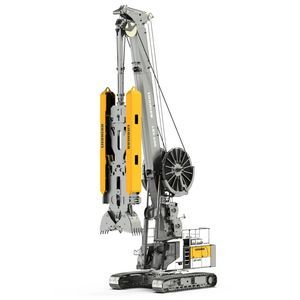
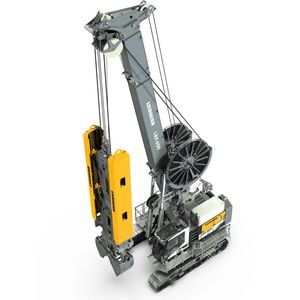
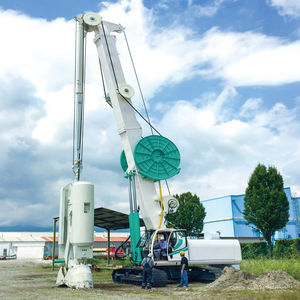
Various types of equipment can be used, depending on the ground conditions and the project: kelly-mounted or hang grab, KS 3000 or Hydrofraise. The widths can vary from 0.52 to 1.52m : standard widths are 0.62, 0.82, 1.02 m.
Depths of 35 to 50 m are commonly achieved. The Hydrofraise can reach 150 m.
Operations generally proceed with adjacent primary and secondary panels.
The length of panels may vary from 3 to 20 m : 5 to 6 m is the common average size.
JOINTS: In most cases, use is made either of stop-end casings or Stopsol-type joints which are withdrawn once concreting of the primary panel is completed or CWS-type joints with lateral withdrawing. With the Hydrofraise, it is also possible to dig short secondary panels with the cutters biting in the concrete of the adjacent primary panels, thus making a direct concrete to concrete joint.
|
|
|
|
|
|
Continuous reinforced concrete core walls are vertical walls made in spans of up to 7 metres in length and thicknesses between 0.45 and 1.50 metres, and depths of up to 70 m, and offer a solution to excavation difficulties in urban areas or around the water table level.
To install core walls in the ground, mechanically-driven grab buckets are used with weight ratings of between 5 and 23 Tons and grab openings of between 2.60 and 4.20 metres. This type of grab bucket can be adapted to practically any type of soil and depth.
To install core walls on rocks, excavation techniques and plant is used for thicknesses of 0.60, 0.80, 1.00 and 1.20 metres and depths of up to 60 metres.
They are used in a large number of projects (bearing structures, provisional or definitive retaining walls, etc.) and represent a solution to different problems such as the excavation of buried structures such as underground car parks and basements, subways, etc., to the creation of subsoil waterproofing in loose material dams.
|
|
MAIN APPLICATIONS
-Major urban excavations in the aquifer
-Underground reservoirs or access shafts to deep sewers
-Open or below grade trenches :
highways
railways
underground railways
-Deep, load-bearing foundations :
linear X or H-shaped supporting
walls to lower high loads
retaining walls
MAIN PLANT USED
-Cable-operated grab :
width from 520 to 1520 mm
mounted on standard or hydraulic crane
-Hydraulic grab with Kelly :
guided and equipped with inclinometer controlling verticality
possibility of correcting verticality with the so-called "active grab"
-Hydraulic cutter
used in hardened ground
|
|
Circular access shaft, diaphragm wall diameter: 58m,
thickness 1 m, depth: 21 m.
Cutoff curtain 60 m deep (29,000 m2).
|
|
The CDW (Continuous Diaphragm Wall) system is based on equipment that allows cutting a slot in the soil by means of a cutting module, and its immediate filling with concrete. The cutting module has the thickness and the length as set by the project.
The wall installed through a continuous working cycle (excavation and filling) and therefore - thanks to construction times that are thoroughly active - industrial productions are considerably higher compared to those obtained by means of traditional techniques.The particular system adopted to discharge the waste material, which is not polluted with the presence of mud, contributes in making the whole working area extremely clean.
|
|
|
|
|
|
Definition:
reinforced concrete wall moulded in the ground where the excavation (typical 2,8m with 8,5m) is held open using a purée containing bentonite
Characteristics:
thickness of the wall 0.5m, 0.6m, 0.8m, 1m, 1.2m and 1.5m
standard depth until 35m, exceptionally until 55m and more
sealing waterkering wordt gegarandeerd door een dubbel waterstopvoegprofiel
vertical capacity bearing non-negligable
length of the panel is equal to either once the length of the hook or approximately 2.5 times the length. The length of the hook is approximately 2.8m with 3.3m (standard of hook).
low walls guides necessary
it is necessary to envisage place for the bentonite power station (100m ²)
considerable joists of installation of the building site
traditionally not of continuous horizonteaux reinforcements in the slurry trench walls: beam of distribution in head necessary.
Scope of application:
wall retaining the grounds and water
resumption of the vertical efforts
excavations along the existing buildings
|
|
PRECASTING OF PANELS
The panels are made of reinforced or prestressed concrete.
Precasting is done in an industrial process; manufacturing of heavy panels of 40 tonnes is commonly achieved.
Whenever possible, the precast factory is installed on the site. If this is not feasible, the panels are brought on trailers from an outside precasting yard.
|
|
The name refers to a cast in place wall, excavated with conventional equipment under bentonite slurry. Subsequent concreting is done with a deformable, watertight, plastic concrete, composed of 100-200 kg/m3 cement, 1,800-2,000 kg/m3 well graded aggregate and 30-40 kg/m3 bentonite. Typical wall thickness is 0.6 m. Installation is done by alternate panels and stop-end tubes are used.
This method allows to install very deep walls (50 m or more), but for very large depths, wall thickness should be increased to 1 or 1.2 m in order to reduce the risk of gaps near panel joints which may be caused by deviations.
|
|
Keller Slurry Walls are formed by using a specially formulated mix of cementitious and bentonite based materials together with proprietory additives to provide a plastic structure that offers extremely low permeability with a degree of flexibility.
Demanding current specifications have been proven in practice by the Keller mix design. These generally require permeability in the range of 10-8 to 10-9m/s, strains in excess of 5% without failure, and strengths typically of 100-300kN/m2.
The wall can form a barrier to the passage of leachates and ground water flows, to prevent the contamination of adjacent ground and water courses.
|
|
Thick slurry cut-off walls are diaphragm-type walls made of bentonite-cement. The trench is usually dug by grab, the permanent cement mix can be used as drilling mud to support the trench during excavation.
When a Hydrofraise rig is used, the bentonite-cement mix must displace the drilling mud as each panel is completed. The joints between panels are formed by having the second trench bite overlapping the primary panel.
|
|
This name comes from the thickness of the d-wall which is about 10 to 20 centimeters.
The wall is constructed by driving a steel beam into the ground then extracting the beam while injecting a waterproof grout into the cavity thus formed. Then the beam is repositioned to overlap the previously filled cavity and so forth.
The beam can be hammered or vibrated (with or without jetting) to the required depth. Since, with this method, the ground is compacted rather than excavated, the wall depth is limited to 20-25 m even using the most powerful equipment; in addition, this method does not apply to all types of ground.
|
|
Diaphragm walls are walls produced in soil with so-called cast-in-place concrete, which can reach high depths. The walls are built with a low noise and vibration method; its thickness depends on the structural usage and the equipment used. Diaphragm walls have small deformations, and are therefore mainly used in inner-city foundations as retaining wall. Due to their relatively high water tightness they are also suitable as external wall for the future structure. In special cases, individual diaphragm wall elements are applied for foundations.
Cut-off walls seal dams and retain landfill sites, tank storages or other industrial plants that may jeopardize the ground water.
|
|
Definitie:
grouting curtain made up of purée cement-bentonite.
Characteristics:
permeability and compressive strength are according to the composition of the purée cement-bentonite
hardening slow of the purée cement-bentonite
standard depth until 35m, occasionally until 50m
veil does not have a function of ground reserve, the geometry of the ground must be self-stabilizing
veil is rather flexible wand to follow displacements of the grounds
Scope of application:
veil of reserve water to pouir insulation of pollution, discharges, etc
limitation of the folding back (quantities, zone of influence) dasn of the great projects of infrastructure (walls of quay, aquaducts, entered of the tunnels)
|
|
This type of wall, known in North America as "slurry trench", is a cutoff wall made of a mixture of bentonite and aggregates. A fairly wide trench (commonly 5 ft) is excavated under bentonite slurry.
Excavated materials (aggregates) are placed in the trench in such a way that the backfilled aggregates form a gentle slope in the opposite direction from ongoing excavation.
To ensure an effective cut-off effect, slurry trenches must be rather wide so as to compensate the possible defects due to the simple dumping procedure.
|
|
Various types of equipment can be used, depending on the ground conditions and the project: kelly-mounted or hang grab, KS 3000 or Hydrofraise. The widths can vary from 0.52 to 1.52m : standard widths are 0.62, 0.82, 1.02 m.
Depths of 35 to 50 m are commonly achieved. The Hydrofraise can reach 150 m.
Operations generally proceed with adjacent primary and secondary panels.
The length of panels may vary from 3 to 20 m : 5 to 6 m is the common average size.
JOINTS: In most cases, use is made either of stop-end casings or Stopsol-type joints which are withdrawn once concreting of the primary panel is completed or CWS-type joints with lateral withdrawing. With the Hydrofraise, it is also possible to dig short secondary panels with the cutters biting in the concrete of the adjacent primary panels, thus making a direct concrete to concrete joint.
|
|
|
|
|
|
Continuous reinforced concrete core walls are vertical walls made in spans of up to 7 metres in length and thicknesses between 0.45 and 1.50 metres, and depths of up to 70 m, and offer a solution to excavation difficulties in urban areas or around the water table level.
To install core walls in the ground, mechanically-driven grab buckets are used with weight ratings of between 5 and 23 Tons and grab openings of between 2.60 and 4.20 metres. This type of grab bucket can be adapted to practically any type of soil and depth.
To install core walls on rocks, excavation techniques and plant is used for thicknesses of 0.60, 0.80, 1.00 and 1.20 metres and depths of up to 60 metres.
They are used in a large number of projects (bearing structures, provisional or definitive retaining walls, etc.) and represent a solution to different problems such as the excavation of buried structures such as underground car parks and basements, subways, etc., to the creation of subsoil waterproofing in loose material dams.
|
|
MAIN APPLICATIONS
-Major urban excavations in the aquifer
-Underground reservoirs or access shafts to deep sewers
-Open or below grade trenches :
highways
railways
underground railways
-Deep, load-bearing foundations :
linear X or H-shaped supporting
walls to lower high loads
retaining walls
MAIN PLANT USED
-Cable-operated grab :
width from 520 to 1520 mm
mounted on standard or hydraulic crane
-Hydraulic grab with Kelly :
guided and equipped with inclinometer controlling verticality
possibility of correcting verticality with the so-called "active grab"
-Hydraulic cutter
used in hardened ground
|
|
Circular access shaft, diaphragm wall diameter: 58m,
thickness 1 m, depth: 21 m.
Cutoff curtain 60 m deep (29,000 m2).
|
|
The CDW (Continuous Diaphragm Wall) system is based on equipment that allows cutting a slot in the soil by means of a cutting module, and its immediate filling with concrete. The cutting module has the thickness and the length as set by the project.
The wall installed through a continuous working cycle (excavation and filling) and therefore - thanks to construction times that are thoroughly active - industrial productions are considerably higher compared to those obtained by means of traditional techniques.The particular system adopted to discharge the waste material, which is not polluted with the presence of mud, contributes in making the whole working area extremely clean.
|
|
|
|
|
|
Definition:
reinforced concrete wall moulded in the ground where the excavation (typical 2,8m with 8,5m) is held open using a purée containing bentonite
Characteristics:
thickness of the wall 0.5m, 0.6m, 0.8m, 1m, 1.2m and 1.5m
standard depth until 35m, exceptionally until 55m and more
sealing waterkering wordt gegarandeerd door een dubbel waterstopvoegprofiel
vertical capacity bearing non-negligable
length of the panel is equal to either once the length of the hook or approximately 2.5 times the length. The length of the hook is approximately 2.8m with 3.3m (standard of hook).
low walls guides necessary
it is necessary to envisage place for the bentonite power station (100m ²)
considerable joists of installation of the building site
traditionally not of continuous horizonteaux reinforcements in the slurry trench walls: beam of distribution in head necessary.
Scope of application:
wall retaining the grounds and water
resumption of the vertical efforts
excavations along the existing buildings
|
|
PRECASTING OF PANELS
The panels are made of reinforced or prestressed concrete.
Precasting is done in an industrial process; manufacturing of heavy panels of 40 tonnes is commonly achieved.
Whenever possible, the precast factory is installed on the site. If this is not feasible, the panels are brought on trailers from an outside precasting yard.
|
|
|
|
|
|
My Geothermics with selected to pose the products
Wagner & Co one of the leaders of solar in Germany:
An innovative company with an important know-how and an experiment of more than 25 years.
Manufacturing solar installations with an offer produces very broad compact unit for individual housing to the collective installations, solar roofings and frontages.
Distribution by the means of My Geothermics and a network of professional fitters specialized in Germany and more than 10 European countries.
They Propose:
Solar installations for preparation of domestic hot water and supplement heating
Kits optimized for houses with one or two residences
Collective solar installations and heating networks solar
Complete solar roofings (Solar-roof)
Solar frontages
Photovoltaic solar installations for exploitation connected to the network or exploitation in isolated site
Complete and detailed technical informations in format paper or numerical.
At My Geothermics a Photovoltaic Service special with an Interlocutor file,
Mr. Cotelle Reachable Frederic to the 06-86-08-73-41 or frederic.cotelle08@orange.fr
|
|
The ALYPLANO panels are metallic panels with insulation made of rigid polyurethane foam fit for the realisation of Roofs Coverings of industrial building.
The ALYPLANO panels present good performance of FIRE RESISTANCE.
The ALYPLANO panels are constituted of two trapezoidal or microgrooved metallic supports with interposed insulation of rigid polyurethane foamo.
METAL SUPPORT:
The REPI FIRE panels are made of two trapezoidal, microgrooved or flat metallic supports obtained by cold-process profiling the sheet coils.
The materials which are used are:
- Galvanized Steel
- Prepainted Galvanized Steel
- Natural Aluminium
- Prepainted Aluminium
|
|
|
|