|
|
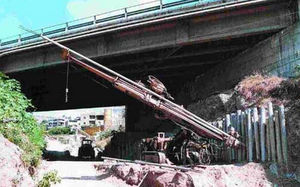
Keller Ground Engineering offers the widest range of anchorage systems available in the UK. As one of the world's leading ground anchorage contractors, Keller has unrivalled experience in designing and installing anchorage systems for a wide variety of construction projects, including dams, ports and harbours, deep basements, roads and bridges, slope stabilisation schemes etc.
Through innovative engineering, Keller has developed installation techniques and systems to enhance the available frictional and cohesive capacity of the soil. This ensures that the anchorages installed are not only extremely efficient in utilising ground strength, but also provide an economic solution. This applies to most ground conditions from granular soils through mixed to cohesive soils and in all rock types.
|
|
The MANTA RAY ® anchoring range was designed for use in places where great strength is needed.
MANTA RAY ® devices are currently being used in civil engineering, military engineering, sub-marine operations, etc.
|
|
Ground anchors have been used for years in civil engineering works to ensure the stability of embankment sheet pile walls.
The first bored and pre-stressed ground anchors, however, only appeared some fifty years ago.
The ground anchor is a tensioned device used to stabilise the
construction to which it is fixed in loose or rocky soil.
The pre-stressed anchor rod combines two totally different specialties :
-geological knowledge of the ground
-pre-stressing of the steel
|
|
|
|
|
|
A ground anchor transmits the tensile forces applied to it to a competent stratum.
It consists of three parts:
- The head, transmitting the anchor force to the structure via the bearing plate.
- The free length of tendon, from the head to the near end of the anchorage.
- The grouted anchorage, which is the length of tendon by which the tensile force is transmitted to the surrounding ground through the intermediary of the grout.
There are "active" and "passive" soil anchors:
A passive soil anchor is tensioned as the structure itself applies load to it. It does not usually have a free length of tendon (it is grouted over its whole length).
An active soil anchor is pretensioned before it takes up the load, which is a means of limiting deformation.
Anchor capacity ranges from a few tonnes to 1,500 tonnes. The usual range is 20-200 tonnes.
Overall length is specific to each project, ranging from 10 to more than 60 metres. They are commonly 15-25 metres long.
Tendons are usually of the type used in structural prestressing, or similar.
|
|
|
|
|
|
A ground anchor transmits the tensile forces applied to it to a competent stratum.
It consists of three parts:
- The head, transmitting the anchor force to the structure via the bearing plate.
- The free length of tendon, from the head to the near end of the anchorage.
- The grouted anchorage, which is the length of tendon by which the tensile force is transmitted to the surrounding ground through the intermediary of the grout.
There are "active" and "passive" soil anchors:
A passive soil anchor is tensioned as the structure itself applies load to it. It does not usually have a free length of tendon (it is grouted over its whole length).
An active soil anchor is pretensioned before it takes up the load, which is a means of limiting deformation.
Anchor capacity ranges from a few tonnes to 1,500 tonnes. The usual range is 20-200 tonnes.
Overall length is specific to each project, ranging from 10 to more than 60 metres. They are commonly 15-25 metres long.
Tendons are usually of the type used in structural prestressing, or similar.
|
|
The STING RAY ® anchoring range was designed for use in places where great strength is needed or in soils whose retention capacity.
STING RAY ® devices are currently being used in civil engineering, military engineering, sub-marine operations, etc.
|
|
Tie rods are structural elements undergoing traction and suitable for conveying loads to soil depths.
Tie rods are made of an active part, the bond length, and a passive part, that transfers the stresses from the anchoring head placed on the anchor wall to the soil. Tie rods can be grouted either by low pressure or by high pressure, while, with reference to their duration in time, they can be divided into temporary and permanent tie rods.
|
|
Ground anchors are structural elements where a grout body is produced in the subsoil by injecting grouting mortar around the rear part of a steel tendon. The grout body is connected by way of the steel tendon and the anchor head to the structure or the rock section to be anchored.
Any load to be taken up by the grouted anchor is passed into the subsoil not over the entire length of the anchor but only in the area of the grout body. The steel tendon section where the anchor is free to expand is the free tendon length.
It acts like a spring which can be pretensioned to the structure against the subsoil. Grouted anchors are subjected to tension only. Their load capacity is checked by pre-tensioning.
|
|
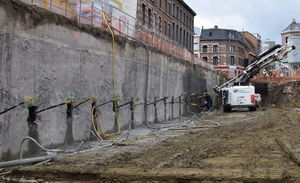
Earth or rock anchors generally consist of steel elements (bars or strands) grouted in a drilled hole. The bars or strands are subsequently tensioned. This provides lateral or vertical force to resist movement of a retaining structure. Anchors are often used for excavation support, or as a part of permanent retaining walls, or to resist up-lift forces on foundations. Rembco uses rock anchors to stabilize slopes and walls, provide tiebacks for bridges, stabilize dams, and secure caisson bottoms.
Anchors and bolts can have very high load capacities. over 25 years, Rembco has installed many different sizes and lengths. The largest had a working load of 1,000 kips.
|
|
In the wide spectrum of building techniques injection anchorage has become an important element offering new possibilities in all building branches. This instrument has made it possible to excavate with no more disturbing rigid sections, fenced walls are anchored, as well as winched walls, steep ground, supporting walls and peer walls. Injection anchorage is a technically elegant and fast solution for many building works.
SAMER ANCHORAGE is made of reinforced centrifugated concrete and can be inserted in any kind of ground or rock, provided the ground can tolerate the necessary static traction forces.
|
|
Definition:
an axial element is placed in a seal and borehole in the ground by injection. By friction the load is transmitted towards the ground. The ties are pressurized, the nails are passive.
Characteristics:
strands of prestressed or bars of steel or lost borehole tubes: section and characteristic of steel are determined by the fourniceurs (EP Diwidag, Ischebeck, Fressinet)
provisional and final ties (different protector from corrosion)
gravitating injection, IGU (injection total to unitair) and IRS (injection repetitive and selective)
possibility of exécutioncomplètement dismountable
give the responsability max to be taken again is determined by the characteristic of ground and the type of injection (gravitating, IGU, IRS)
Scope of application:
reserve of pressure earth and water, macadam binding
resumption of the tractive efforts on the constructions requested by the water uplift
|
|
| ... products without information |
| |
|
|