|
|
The micropieu is a low-size drilled pile (diameter lower than 250 mm). Its use is conditioned by the degree of accessibility to the building sites and the efforts to be begun again (weight of the work).
It is in particular used within the framework of recoveries in underpinning (villas, buildings, historic buildings...) and in the special foundations (works of art, constructions out of building...).
|
|
|
|
|
|
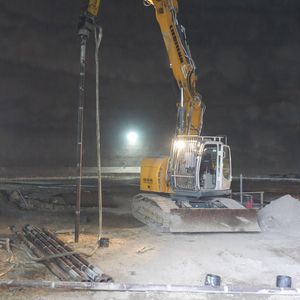
Keller Ground Engineering offers a range of high capacity small diameter drilled and bored pile systems purposely designed to tackle difficult ground conditions and working in limited space and low headrooms.
Highly versatile, compact but powerful rigs, can install piles in virtually any location whilst being able to tackle drilling through different soils, obstructions and forming substantial rock sockets.
Keller's drilled Minipiles are available in diameters of up to 350mm and in appropriate soil conditions can provide safe working loads in excess of 1000kN. Widely used for refurbishment of buildings, Minipiles are utilised for upgrading of existing foundations by stitch drilling or underpinning and for the provision of retention schemes, i.e. basement walls within limited access and headroom. Keller Minipiles are also used extensively in the infrastructure sector for forming earth retention systems to support unstable embankments and cuttings etc. and strengthening of existing foundations.
The Keller Minipile system operates with very low levels of noise or vibration and is highly suited to built up urban environments. Piles can be constructed in headroom as low as 2.1 metres.
The pile shafts are constructed from cement-based grouts with cage, bar or other reinforcement appropriate to the application.
|
|
|
This nomenclature refers to piles of small section and low to medium load capacity. The basic principle is to install these piles with small, light and manageable equipment, and to use them wherever conventional equipment is unable to operate; underpinning, strengthening, bracing, take-up of bending and tensile loads due to fill, resistance to negative friction, etc.
|
|
erratest has the technical capacity and know-how to install micro-piles using its highly-qualified personnel to offer the best solution and to execute the project once that solution has been decided upon.
Terratest has the most up-to-date equipment thanks to its ambitious yearly programs of capital investment, which enables us to remain permanently at the forefront of quality and productivity.
Some of the applications where Terratest develops its micro-pile technology are:
* Underpinning
* Foundation strengthening for building extensions
* Strengthening of existing foundations for basement excavation
* Deep foundations in soils not apt for conventional piles
* Umbrellas for tunnel mouths
|
|
Micro-piles enable the implementation of foundations for new structures or
the reinforcement of old structures in confined spaces.
This method consists of transferring the loads from the structure to the soil by sinking a small pile (diameter under 250 mm) generally fitted with a metal insert (ribbed blocking bar, tube).
Micro-piles can be used for working in compression, traction or a combination of both.
|
|
Concrete industrial floors often present serious sinking problems.
In most cases, the floor sinks because the foundation has not been carried out properly or because there are deeper layers of soil with poor consistency. The resin-mini pile method is the perfect solution for these issues. Injecting the foamed resins below the floor fills any cavities that have formed, compresses the soil below and raises the floor by as much as 20-30 centimetres until it is perfectly level. By subsequently applying the pressure driven mini piles, the weight is transferred below the soil avoiding any future sinking.
|
|
|
|
|
|
This technology can be applied to:
New buildings, swimming pools, silo bases, concrete beds for any type of structure.
It is common for buildings or constructions on concrete bed foundations to sink in different areas. The buildings tend to remain intact but rotate and tilt to one side or slant on one corner.
During its over ten years’ experience, Novatek has treated and resolved countless similar cases, raising the structure using foamed resins and then securing it into place with micro piles.
To prevent a building or structure built on concrete bed foundations from developing this problem, it is possible to act in advance during the construction phase by using the simple and economic PX780 pressure driven micro piles.
It is necessary to insert jackets alloyed to the reinforcement in the concrete bed. After the concrete has been cast and partially cured, the PX/80 micro piles are driven into the concrete.
The design engineer and calculator will provide indications regarding the degree of weight to offload underground, which could correspond to the weight of the entire building or it could be calculated to guarantee an even and balanced load distribution.
PX/80 micro piles are pressure driven into the ground by a hydraulic jack equipped with a gauge to individually test and certify the necessary driving pressure and the effective load bearing capacity of each micro pile.
|
|
|
|
|
|
The MP/50 MINI PILES, or the steel-cement tubes, are noiselessly pressure driven through the holes. There is no need to remove any soil and special anchors fixed to the structure are used to secure the hydraulic jack.
These elements are installed in sequence and secured together using a pressed coupling. The hydraulic jack is equipped with a gauge, which indicates the pressure required to drive the steel-cement piles into the soil. Therefore, the load of each mini pile is tested individually. When the mini pile reaches a stratigraphic formation which allows it to resist the desired drive force (which can vary from a minimum of 8,000 kg to a maximum 12,000 kg) the jack is removed and the MP/50 MINI PILE is internally and finally cemented into the foundation. Considering the reduced dimensions of the mini piles, the holes do not weaken the foundation and the foundation does not need to be reinforced in terms of dimensions and structural rigidity. The mini piles are easy to install using machines requiring little clearance, which can also access cellars and confined spaces in general.
|
|
|
|
|
|
Micropiles allow solving some problems concerning the execution of foundations thanks to the possibility of using equipment having reduced sizes and encumbrance, and to the minimum disturbance caused to the soil and pre-existing structures.
MICROTREVI I is particularly suitable for being executed in soils that can be drilled by means of the rotation technique. In these cases, the same steel pipe making up the reinforcement of the micropile is used as drill string during the boring phase. To this aim, its bottom side is provided with a sacrificial three blades bit (drag bit). Close to the bonded length, the pipe is equipped with special non-return valves, "VELANOR" type, that are housed within the pipe thickness so that they are not damaged during the drilling phase. Said valves allow - whenever requested - to re-grout the micropile in a following time.
MICROTREVI II doesn't require the formation of a cement sheath for its execution, since the shaft of the micropile is plitted by means of bag packer. The single sections between bag and bag are subsequently pressure grouted. Said method assures an improved control over the grouting pressure and it allows grouting into those formations which would require excessive pressures due to the failure of the sheath, with following claquage risks.
|
|
Micro piles are foundation elements up to a diameter of 300 mm, being able to transfer loads through skin friction into deeper, competent soil stratums.
The special feature about micro piles is a.o. that a high bearing capacity is possible due to well-targeted injection techniques with small diameters.
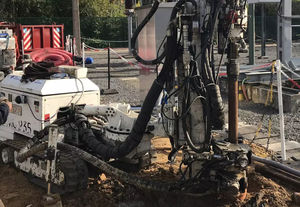
A great variety of rigs and equipment enable highly productive methods to install mini piles even at limited working space.
Buildings damaged by erratic settlements can be stabilised and/or lifted by prestressable mini piles.
|
|
|
Micropiles are small diameter drilled and grouted friction piles. Each pile includes steel elements that are bonded into the bearing soil or rock - usually with cement grout. The bearing stratum is logged during installation drilling to assure that bearing capacity is adequate. Micropiles do not rely on end-bearing capacity, so there is no need to establish the competency of rock beyond bond-depth. They can be installed quickly in virtually every type of ground using highly adaptable mobile drilling equipment. These steel piles have working capacities up to 250 tons.
|
|
|
|
|
|
The pressure driven mini piles mean it is much easier, practical and faster to increase the load bearing capacity of industrial floors or existing foundations for the installation of heavy or precision machinery, the construction of indoor metallic infrastructures, the installation of automated warehouses, overhead travelling cranes and mezzanines.
Generally, in all these cases, suitable foundations have to be installed (consisting in adequately sized plinths).
To do this, it is necessary to break up the existing floor, remove earth, install reinforcements and cast concrete.
These are invasive procedures and are not always easy to carry out within an existing structure. By simply installing pressure driven mini piles, Novatek is able to increase the load bearing capacity of a normal industrial floor so that it is able to support the new required loads. Machinery weighing hundreds of tonnes no longer requires a huge base which takes a long time to create and is highly invasive. All you need to do is install a series of mini piles whose layout and capacity is designed and calculated according to your specific requirements. The absolute reliability and safety of the process is guaranteed by the fact that the effective load bearing capacity of the mini piles is individually tested and certified.
|
|
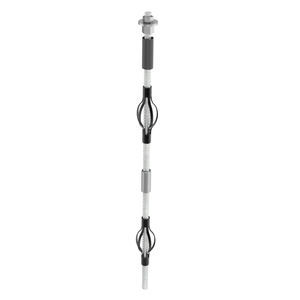
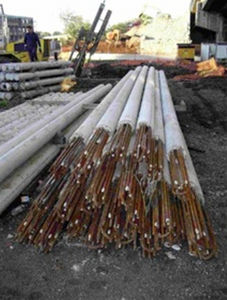
Prefabricated Concrete Micropiles are reinforced centrifugated concrete pipes for special foundations. The friction between pile and surrounding land is assured by the lateral high pressure injections of cement (without packer).
The installation is like normal micropiles. In few minutes a simple machine can put the pile in the hole, and a workman completing all the injections.
Usual diameter : 210 mm
The most important advantages are :
- velocity of the work
- reduced cost
- high load capacity
- best protections about pitting
|
|
Piles moulded in place, mini-piles
These piles are set up by repression of the ground and thus almost do not produce materials to be evacuated. This technique, simple and rapid to be put in %u0153uvre, are particularly adapted to grounds ready to be driven back laterally clays type, marnes, sands. These piles are provided metal d%u2019armatures in order to ensure a greater rigidity to them and to allow their the superstructure liaisonnement.
So d%u2019assurer the follow-up quality of the building site, each pile moulded in place has a card d%u2019enregistrement individual of the parameters of sinking and concreting. In the same way, a control of the bearing capacity of this type of pile can be carried out by the realization d%u2019un test of loading jusqu%u2019à 1,5 times the load with l%u2019ELS (Absolute limit of Service). In addition, of the concrete samples are taken according to a definite pre frequency.
|
|
Definition:
pile of small diameter (1000kN)
possible in all the directions
reforcé by bars or lost tubes of frage
measurements against possible corrosion
grouting until >15bar
IGU (total injection to unitair) or IRS (repetitive and selective injection)
execution with electric machines possible
Scope of application:
execution of foundations or resumptions with reduced workspace, without vibrations
restoration or underpinning of buildings
when it is necessary to cross obstacles under ground (blocks of rock, mansoneries, concrete not armed, etc)
resumption of the tilted loads (> 20° with the vertical)
|
|
| ... products without information |
| |
|
|