|
|
The Argo structural system consists of a plane prestressed reinforced concrete slab with an open end; the slab is combined with pillars (including PVC rainwater down-pipes and overhead travelling crane bracket if needed), prestressed reinforced concrete %u201CTH%u201D ground beams, closing gables
The Argo diminishing cross-section allows water to flow on the external edges, thus bypassing the construction of inside building sewer and drainage systems; in the event of extraordinary rainfalls the extrados shape and width allow a remarkable storage capacity and a fast draining of waters.
|
|
The Zephir structural system is the latest and most developed output of the company%u2019s production research path; Zephir consists of microshed slabs, plane ground beams and closing reinforced concrete or sandwich gables.
The Zephir system was developed by our Precast Division in cooperation with the Faculty of Engineering in Parma, Italy: the output is a prestressed reinforced concrete element used in the roofing of wide surface areas; it has excellent technical and functional features and a high architectural value.
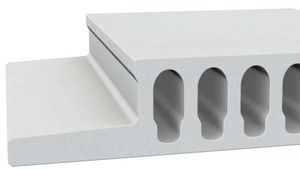
Its tubular section provides the product with a remarkable traverse camber stiffness, which envisages long-term window frame duration, while the wide surface base guarantees high stability and makes it particularly safe during installation.
Thanks to its high storage capacity and its shape, water, however abundant, flows naturally rapidly and effectively on it.
|
|
The Pegaso structural system%u2019s main feature is a plane prestressed reinforced concrete slab with an open edge and diminishing in cross-section. The Pegaso slab is combined with pillars (including PVC rainwater down-pipes and overhead travelling crane bracket if needed), TH ground beams and closing gables.
The Pegaso slab diminishing in cross-section allows water to flow through the external edges, thus bypassing the construction of inside building sewer and drainage systems; in the event of extraordinary rainfalls the extrados shape and width allow a remarkable storage capacity and a fast draining of waters.
|
|
|
|
|
|
This is the fruit of the constant commitment of Mabo in the research of new solution for prefabricated construction.Euroalares is a revolutionary roofing-tile, as a new interpretation of a well-known shape conjugating the transportability and the possibility of stacking with the lightness primary exigencies. The long study of the shape, investigating the morphologies that are far from the classic pre-assembled civil engineering, gives high level visual and plastic results, reminding the regularity of the arched multiple-spans and the contemporary realizations of the organic architecture.
description
Euroalares is revolutionary as regards its design, and all the aspects of the plant manufacture and manufacturing process.
We can see clearly in the tile a supporting and a supported part.
The main framework is constituted by two lateral arches in reinforced concrete, preassembled to the transversal little beams, to the supports and to the rectilinear and longitudinal chain placed in the centre line.
This main framework is braced suitably, inside the surface created amongst the arch, the chain and the transversal little beams. The surface of the tile is realized in light concrete; the material used combines a high fire resistance and a high insulating power, so this high performance element can assure a great thermal comfort without any following insulating manufacture.
|
|
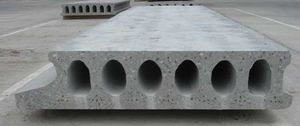
Concrete roof elements (Double T units) are mainly used in residential construction and long span industrial and commercial buildings, such as sport halls. The Consolis Group produces two main types of elements: namely ribbed lightweight roof units and hollow-core slabs. These components are usually prestressed.
The main features of the elements are:
* Light weight due to slender cross-sections
* Large spans
* Smooth soffit
* Easy and quick to install
|
|
|
|
|
|
The natural evolution of the system building is going over the role played till now, a simple executor of structures that must be covered and visible only after a second project phase of "adjustment". The ambition of the system building is to consider all the level of use of a building, to shape itself according to the natural light, the plant engineering and all the climatic requirements
description
The roofing-tile president has an "omega-shaped" cross section, where the vertical walls rise from the extrados to create a great natural drain of storm water. They have a swelling in the lower parts for an excellent spread of the prestressing reinforcement, a natural good support for any eventual ceiling element and a hidden platform for little cable ducts or fixing for eventual cases to place in the tile intrados. The finishing is semi washable white paint varnish on basis of aqueous anion resin.
Each tile is insulated in the extrados placing an insulating board on the slab; the waterproofing is realized through alluzinc plates fixed through an automatic stapling machine assuring a perfect sealing of the superimpositions.
The breadth of the flat surface offers many possibilities for a good practicability and sitting plants and machinery.
Some insulating ceiling plates are placed between the tiles and are surmounted by some cover slabs. This interspace represents an airing room with effect "cold roof" involving many good effects with regard to the interior thermal comfort.
|
|
| ... products without information |
| |
|
Bituthene® Deck System combines Bituthene® 4000 sheet membranes with Bituthene Deck Prep® to provide a durable waterproofing system capable of accepting a wide variety of wearing surfaces on above occupied space, inverted roofs, green roofs and elevated concrete deck.
|
|
|
|
|
|
Kalzip structural deck roof system
The Kalzip structural deck roof system provides an economical solution for long span installations and eliminates the need for purlins. For enhanced acoustic absorption, decking sheets can be perforated and can support mass, such as increased insulation or board, which may be introduced for more rigorous acoustic specifications.
Where structural decking is installed there is a reduced requirement for secondary steelwork. The Kalzip structural decking sheet is generally laid transverse to the direction of the Kalzip standing seam roof sheet and spans between the main steel rafters. Typical rafter centres would be approximately 3 to 8 metres.
The Kalzip clips are installed in a diagonal layout so that all external roof loads can be evenly distributed to the structural decking sheet. The frequency of clips may be increased at theperimeter of the building where higher wind loads occur.
The gauge and profile of the Kalzip structural decking sheet is therefore determined by the rafter centres, all external roof loads, internal wind loads, service loads (e.g. lighting) and the dead weight of the construction components.
|
|
RIVERCLACK ELIOS DECK allows to fix the panels to the already existing metal roof without compromising at all its integrity and reliability.
ELIOS DECK is made of UNISOLAR photovoltaic laminates glued and mechanically seamed onto a metal support (the deck); in this way, the adherence of the PV laminate to the support is guaranteed for the whole life of the photovoltaic module, even in extreme weather conditions.
The ensemble laminate + support (ELIOS DECK PANEL) fits in the RIVERCLACK or RIVERGRIP sheets thanks to a snap mechanism and adheres to the flat part of them achieving in that way a perfect architectural integration.
Nonetheless, the ELIOS DECK panels can be mounted or dismounted at any time.
|
|
|
|