|
|
|
|
|
|
Pre-fabricated geocomposite drain for use as a combined drainage and protection layer with Grace waterproofing membranes
Description:
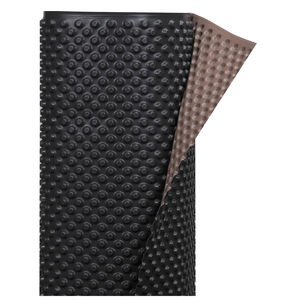
Hydroduct® 220 is a strong, preformed 0.433 in.(11 mm) thick geocomposite drainage sheet system, comprising a hollow studded polystyrene core, covered on one side with a nonwoven, needle punched polypropylene filter fabric and on the other side with a smooth polymeric film.
Advantages:
- Enhances waterproofing-eliminates hydrostatic pressure build-up
- Efficient water collector/deflector-can be used as a sandwich drainage layer between lagging and the reinforced concrete structure
- Smooth polymeric sheet-compatible with Preprufe®, Procor®, or Bituthene® membranes
- Simple convenient drainage and protection layer-serves as robust membrane protection and drainage
- Geotextile fabric filter-allows ground water to pass into the drain core while restricting the movement of soil particles
- High flow capacity-drains 16 gals/min./ft (200 L/min./m) width
- Rot proof-unaffected by permanent immersion in water, bacteria, dilute acids and alkalis
- Economical-eliminates imported aggregate drainage layers
- Studded core-allows water to flow to designated drainage collection points
|
|
|
|
|
|
Enkadrain Premium drainage mats are high performance geocomposites with an outstanding drainage capacity, both on low gradients and under extreme loads.
When used at great depths or in special applications, products from the Enkadrain Premium range show what they can do. Enkadrain Premium has a drainage capacity easily meeting the DIN 4095 standards (Germany, drainage for protecting structures). And, of course, all Enkadrain Premium products also meet requirements as a protective layer to waterproofing membranes according to DIN 18195 (Germany). In addition to its outstanding drainage capacity, the three-dimensional core of looped polyamide monofilaments provides sound insulation properties. Enkadrain Premium products absorb vibration from nearby sources of noise, such as surface and underground railways, reducing noise transmission levels significantly.
Which is the right Enkadrain product for your project depends mainly on construction depth. Drainage mats from the Enkadrain Premium product range are the ideal solution for draining buildings with multiple basement levels. Their technical design and resulting high performance makes them suitable for deep structures which have to be drained: Enkadrain ST and Enkadrain TP in particular are best suited to deep basement applications.
Enkadrain Premium can also be used in cut and cover tunnels, for example, to drain off inflowing water and protect the waterproof sealant. Enkadrain TP was used for vertical drainage on bridge abutments on both the new German Cologne/Rhine-Main and Munich-Ingolstadt high-speed railway lines and uncountable projects of this kind worldwide.
Like all Enkadrain products, Enkadrain Premium's unique looped core structure makes it flexible and easily adapted to even the most complex geometries, for fast, cost-effective installation with a minimum of cutting to shape.
Enkadrain Premium has also proved itself in horizontal drainage for years. Under extensive and intensive green roof areas, Enkadrain 20H and Enkadrain ST can be relied on to drain off excess water safely. Other Enkadrain Premium products are designed to provide drainage underneath parking plaza decks and cobbled pavements.
Where surfaces are to be used by traffic, Enkadrain TP often is the ideal solution to provide pressure-resistant drainage paths.
|
|
PLANTCOTEX ® RACINE can be used at the time of planting or later.
Plantcotex ® Racine is a vertical barrier that definitively eliminates the deformation of road surfaces and pavements and problems caused by the invasion of water, drainage or telephone networks by roots.
A trench is dug all round the plant, the root barrier is inserted vertically and the trench is then filled in again, keeping Plantcotex ® Racine in its vertical position.
Damage by roots is permanently eliminated.
|
|
| ... products without information |
| |
|
Vertical drains improve the consolidation performance of silty, clayey and other saturated soils. Machines developed by Soletanche Bachy install them quickly and economically. Vertical band-drain (such as Desol® developed by Soletanche Bachy) are installed according to a preset pattern, to bring ground water to the surface when the ground is loaded with surcharge fill or other means.
|
|
Vertical drains have a rectangular cross-section. The core is plastic so that it serves as a channel allowing water to circulate freely. This core is surrounded by a thin filter casing made of a material that acts as a barrier to prevent the soil surrounding the drain from penetrating into the core, while at the same time allowing water in.
Vertical drains can be driven into the ground statically or dynamically. In some very soft soils, water jets with the pipe mouth open or pipe drilling can be used.
|
|
|
|
|
|
Vertical drains are installed to reduce the time required to consolidate soft soils by accelerating, with the help of a static surcharge at the surface, the expulsion of their pore water.
The vertical drain is made of a flexible polypropylene core wrapped with a synthetic geotextile filter chosen for its filtration properties and its resistance to abrasions upon installation.
The polymer core, depending on its manufacturer, is found in various shapes of undulations or surmounted with small dowels or vertical strips to maintain the air space between it self and the filter to ensure percolation of the water toward the surface. The vertical drain measures approximately 100 mm (4%u201D) wide by 6 mm (¼%u201D) thick and generally coiled in lengths of 305 metres (1000%u2019).
The drain is inserted in the soil mass with a hollow mandrel mounted on a vertical lead which is, in turn, most often attached and powered by a hydraulic backhoe. Occasionally, the lead is hung from a crawler crane and the mandrel activated by an independent hydraulic power pack. A static force is thus used to insert and anchor the drain at the desired depth. When hard layers of materials are encountered, a vibrator can be attached to some mandrels, or the holes must be pre-drilled with augers or, exceptionally, with drill rigs to overcome the resistance.
|
|
|
The improvement of poor soils by depth vibrators is an innovation of Keller. For the treatment of non-cohesive and cohesive soil formations different types of depth vibrators and various techniques are available. Together with the different methods of soil improvement a wide range of pile foundations and similar foundation techniques are available.
|
|
|
|