


{{product.productLabel}} {{product.model}}
{{#if product.featureValues}}{{product.productPrice.formattedPrice}} {{#if product.productPrice.priceType === "PRICE_RANGE" }} - {{product.productPrice.formattedPriceMax}} {{/if}}
{{#each product.specData:i}}
{{name}}: {{value}}
{{#i!=(product.specData.length-1)}}
{{/end}}
{{/each}}
{{{product.idpText}}}
{{product.productLabel}} {{product.model}}
{{#if product.featureValues}}{{product.productPrice.formattedPrice}} {{#if product.productPrice.priceType === "PRICE_RANGE" }} - {{product.productPrice.formattedPriceMax}} {{/if}}
{{#each product.specData:i}}
{{name}}: {{value}}
{{#i!=(product.specData.length-1)}}
{{/end}}
{{/each}}
{{{product.idpText}}}


Seat height: 50, 46, 43 cm
Seat width: 43, 51, 62 cm
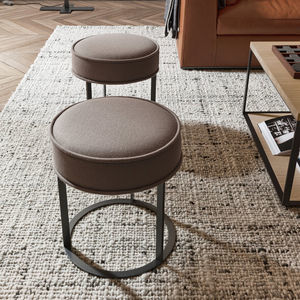
The Caratos ottomans are versatile furnishings that adapt to a vast range of furnishing styles and contexts. They stand out for their openly contemporary nature and for the detail on the base, which recurs throughout the entire Caratos collection: an ...
Seat height: 46 cm
Seat width: 40 cm
Whether used as an additional seat as a decorative element, the Lithos ottoman stands out for its metal frame and rounded seat characterised by a high cushion for exceptional comfort.


Seat height: 46, 40 cm
Seat width: 40, 59 cm
... Small additional seats or decorative elements, the Frank ottomans are available in two versions: with a high round cushions and steel structure in various finishes, or fully upholstered. For both types, the upholstery is available in fabric or leather. Upholstery ...

Seat height: 35 cm
Seat width: 55 cm
... Gold Collection, three oversize objects by Marcel Wanders: a tall vase, a stool and a bowl, all in ceramic covered in gold leaf. Icons of luxury not without a certain sense of humour. ...

Seat height: 45 cm
Seat width: 45 cm
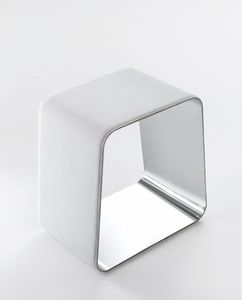
... Bright stainless steel or embossed white, grey aluminium or satin brass colour lacquered metal stool, covered by felt, leather, suede, outdoor fabric (Clivia, Corbezzolo, Narciso) or velvet as per samples. SizesCm (W x D x H) 45 x ...


Seat height: 43 cm
Seat width: 35 cm
Stilemi is a collection that translates key aspects of Alessandro Mendini’s signature style into versatile three-dimensional objects. These pieces have an inherently hybrid essence, so they can be used as seats, small tables or simple support elements, ...
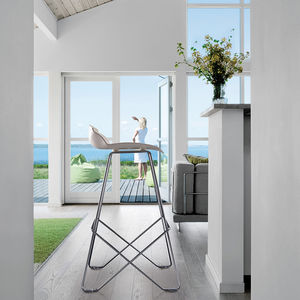
... Kaleidos stool has pure lines, enriched by the very special finishing of the seat surface, which offers three-dimensional optical effects and pleasing reflections; the unusual texture confers a totally new and pleasant tactile effect. ...


Seat height: 44 cm
Seat width: 40 cm
Low table with oak veneer three-leg base. It is provided with glides with felt insert for wood floors. Height 44 cm.
Seat height: 46 cm
Seat width: 63 cm
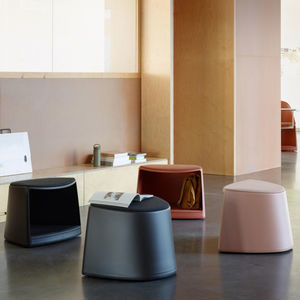
Stool on polypropylene storage base, available in 4 colours, with castors and fitted with cushion applied to the seat in fabric, leather, coated fabric, or customer's material.

Seat height: 40 cm
Seat width: 51 cm
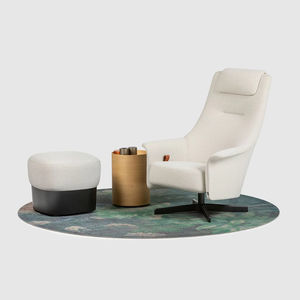
... Comfortable lounge areas are an integral part of contemporary office environments. The PORTS Stool is a fixed part of a comfortable seating landscape. The elegant stool cuts just as good a figure on its own as it does ...
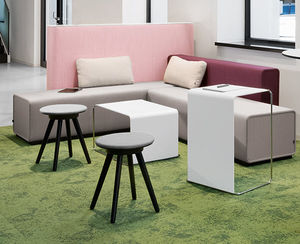
... The new swivel stool by Bene adds dynamism to the office. The TIMBA stool integrates itself in a relaxed and easy manner into informal collaboration and team zones of a modern office. With its consciously informal style, ...

Seat height: 76.5 cm
Seat width: 40 cm
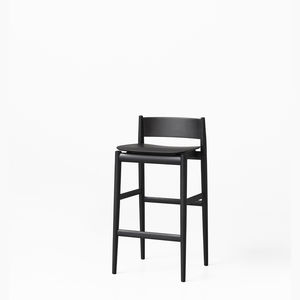
... Higher version of the Neve chair, the Brina stool expands the Porro’s family of chairs. Available in 2 heights, to be functional around a breakfast counter in the kitchen, or for the reception and bar area in the contract, where it ensures ...

Seat height: 42 cm
Seat width: 43 cm
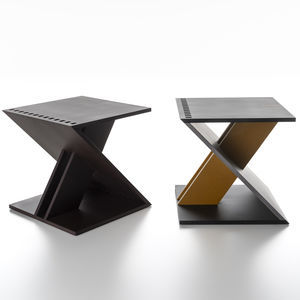
... The Zeta stool, designed by architect Mario Botta, recalls the letter from which it takes its name: two square elements, serving as base and seat, are joined by a diagonal element secured by a comb joint at each end. Two diagonal leaves ...
ALIAS
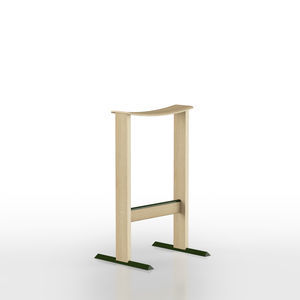
Seat height: 76.5 cm
Seat width: 46 cm
... The Lira collection expands with the introduction of two new stools, designed to provide the same essentiality and refinement as the original model. Designed by Daniel Rybakken, the Lira stool maintains the graphic and ...
ALIAS
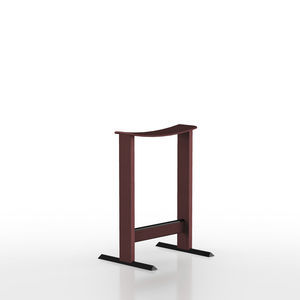
Seat height: 66.5 cm
Seat width: 46 cm
... The Lira collection expands with the introduction of two new stools, designed to provide the same essentiality and refinement as the original model. Designed by Daniel Rybakken, the Lira stool maintains the graphic and ...
ALIAS


Seat height: 38 cm
The frame of this pouf results from the casting of different aluminium alloys, specifically used to enhance the stability, the practicality and the weather-resistance of the product. The quick dry foam padding allow you to use it in different outdoor ...
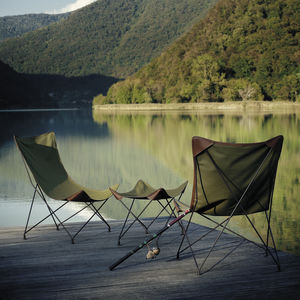

Seat height: 45 cm
Seat width: 76 cm
... combines elegance with a transversal and timeless design. The collection is composed by an enveloping seat and a practical stool made of a cotton cloth, proposed in mimetic colours that matches the outdoor furniture and the landscape, ...


Seat height: 40 cm
Seat width: 40 cm
... Stool stainless steel frame and eco-leather upholstering seat. Characteristics . Produced in our factory in Italy . CE certified materials . Certified Made in Italy accessories ...
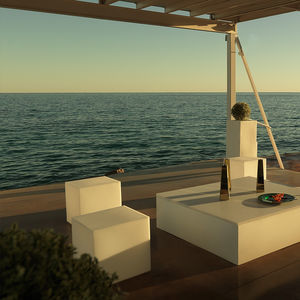

Seat height: 45 cm
Seat width: 40 cm
... modern and avant-garde interiors: lounger, sofa, armchair, chair, armchair, two tables of different sizes, extendable table, stools and high table. Description Made of polyethylene resin by rotational moulding. Weight: 5.5 Kg ...
VONDOM

Seat height: 36 cm
Seat width: 47 cm
... The outdoor furniture’s Wing Collection by A-cero for Vondom, was born as a result of the folding of the straight and curve lines projection mixed in a dynamic way. Description Made of polyethylene resin by rotational moulding. Weight: 5 Kg ...
VONDOM
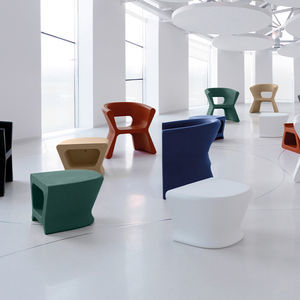
Seat height: 40 cm
Seat width: 60 cm
... Pal is, as the name suggests, a friendly and modern line of indoor & outdoor furniture design by Karim Rashid for the Spanish brand Vondom. This collection is a selection of exclusive, minimalistic and colorful collections of design furniture. Description Made ...
VONDOM
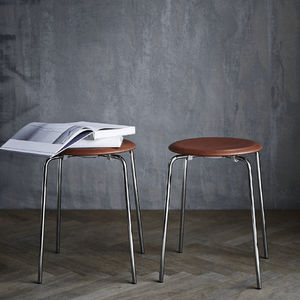

Seat height: 46 cm
Seat width: 34 cm
... Beautiful, simple seating by Arne Jacobsen that can be used as core or extra seating in the office or at home. Modern and minimal, yet sophisticated, this design was used by Jacobsen in multiple, important projects. Beautiful, simple, high seating ...
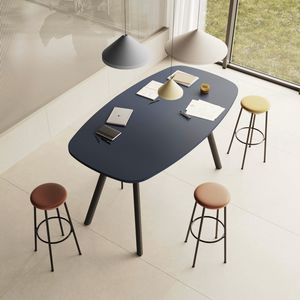

... language of Creva Stool is entirely based on a circular geometry, resulting in a clear-cut, minimalist look. The line-up consists of stools or bar stools, available with either a wooden or metal frame, ...
Nowy Styl
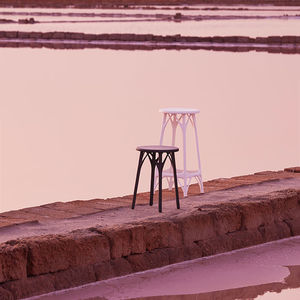

Seat height: 45 cm
... A stool made from recycled material for maximum sustainability. A.I. STOOL LIGHT is sustainable in materials and production process and is the result of thorough optimisation: three models can be made from the same mould, ...
Kartell


Seat height: 45 cm
Seat width: 38 cm
... The practical stool Tabouret Métallique (1936) by Jean Prouvé, which can also be used as a small side table, exhibits structural affinities with the later Trapèze table. ...
vitra USA


Seat height: 390 mm
Seat width: 420 mm
... The iconic Butterfly Stool by the Japanese designer Sori Yanagi is a classic piece of furniture that uniquely combines Eastern forms with the plywood moulding technique developed by Charles and Ray Eames. The gently curving silhouette ...
vitra
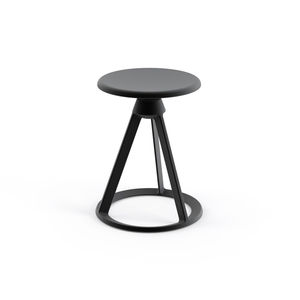

Seat height: 45.7 cm
Seat width: 34 cm
... Piton is a perfect pull-up option or full-time dining chair. The swiveling seat sits atop a cast-aluminum, powder coated base which is a unique reinterpretation of the familiar tripod structure. CONSTRUCTION AND DETAILS Base: constructed of die-cast ...
Knoll international


Seat height: 51, 65, 75 cm
... collection of stools designed by Luca Nichetto to furnish and liven up environments ranging from residential to contract. Karl pays homage to Karl Lagerfeld and his wide raised collars, ideally represented by the curved wooden structure ...
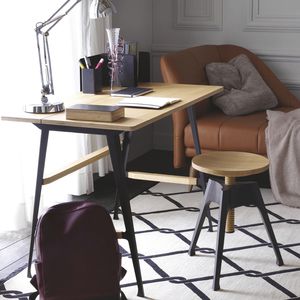

Seat height: 45 cm - 63 cm
Seat width: 45 cm
... Philippe Nigro designed a height-adjustable beech stool to match the desk. ...


Seat height: 68, 78 cm
... Escape any dull space with this sturdy, little wood stool and accompanying table to create a warm and pleasant atmosphere. Suddenly, you will feel anywhere, but at work. For a soft experience, opt for an upholstered seat in one of ...
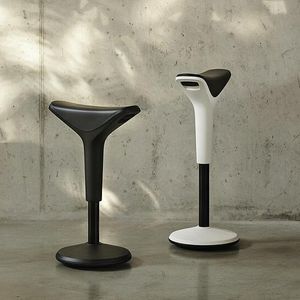

Seat height: 52 cm - 78 cm
... the move. - The one-legged “Rider” becomes a stable three-legged stool with the user's two legs. - With its stepless height adjustment from 52 to 78 cm, it can be used as a dynamic stool or standing aid. - Its rotatability ...
Wilkhahn


Seat height: 45 cm
Seat width: 34 cm
... repurposing the Cocotte stool however they like. A decorative piece, side table, or coffee table companion: one thing’s for sure, we haven’t discovered all the ways this small stool can be used yet. Our décor tip? Pair ...
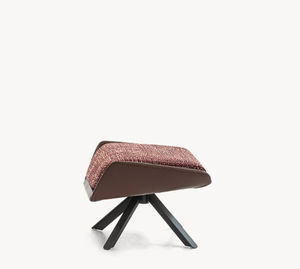

Seat height: 43 cm
Seat width: 56 cm
A seat and its double: on one side it encloses and protects, on the other it opens up and welcomes. A clear ambivalence which elaborately separates form and content, image and concept, the name hood hints at this double function. The hood is both an ancient ...


Seat height: 44 cm
Seat width: 38 cm
... birch. Remaining in continuous production since 1933, Stool 60 has barely changed in either material or form, yet it continues to transcend both time and fashion. With this minimum of components Stool 60 is flat-packed, ...
Artek

A stool is a seat or foot rest which has no armrests or backrest. It can be low or high, upholstered or hard, and may be mounted on a pedestal or on legs. Some pivot or roll on wheels, while others fold or stack. A padded footstool is sometimes called a pouf or an ottoman. ArchiExpo characterizes this furniture by properties such as style, use or material.
ApplicationsA low stool can serve as convenient extra seating indoors or outdoors. Some are used to facilitate bathing, for storage or as a low table. High stools are designed for use with high tables and bar tables. Many such models have a footrest or pivot.
TechnologiesThis furniture can be made of a single material, though many use a combination. Frames, legs and bases are often of tubular stainless steel, aluminum or wood. Wood and thermoformed plastic are commonly used for the seat.
How to chooseWhen choosing, consider seating comfort. Stackable or modular versions are easier to store and present advantages if the stool must be moved often. Proper height and sufficient leg room are important for those used with tables. A stool can blend into its surroundings, or can be a playful design piece which stands out and adds originality to a space.
the best suppliers