|
|
|
|
|
|
Definition:
Pile screwed without vibration with double side repression and was in the shape of propeller on all the height, without vertical transport of ground
Properties:
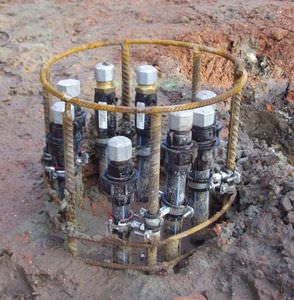
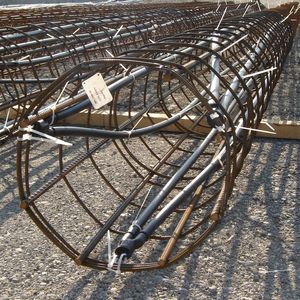
installation of the reinforcement on all the height before concreting
tilted piles possible (up to 1/5)
the section of the pile is determined by the diameter of the propeller and the diameter of the barrel. The diameter of the propeller determines the geological capacity of bearing pressure, the diameter of the barrel determines the organic capacity of bearing pressure. The diameter of the current barrel of 310mm with 610mm is spaced 50mm. The diameter of the propeller of 460mm with 810mm.
without vertical transport of ground, even with the point (side repression).
begun again horizontal efforts by an additional reinforcing cage at the head
it can be necessary of préforer the hard layers (>20MPa).
capacity of bearing pressure until 2000kN
Scope of application:
in the environment sensitive to the sound: <85dBA with 7m of the machine
in the environment sensitive to the vibrations. The pile is installed under the combined effort of screwing and push.
without important drainage of ground
almost all profile them ground Belgians
especially in tertiary clays
|
|
|
Bored Piles are circular piles made of concrete and steel being installed in the soil by various drilling methods. They divert high structural loads into deeper, stronger soils, form stringed together a retaining wall for excavation pits or terraces remove obstacles in the soil or block ground water below the surface. Depending on the application length, diameter, material, formation, and placing of the individual piles can be adapted.
|
|
Drilled piles are often used in 'critical ground' where there is a risk of subsidence. A drilled pile is also used when noise pollution has to be avoided. In addition a drilled pile is used to 'drill out' another pile. Advantage: vibration free and fully ground penetrating. Disadvantage: the costs of drilled piles are higher than those of prefab piles.
Drilled piles were used in the construction of the Goes council offices. The ground turned out to be rock hard because of the fine soil layers containing shells, silt and very fine sand. Because of the central location in the town of Goes drilled piles had to be used for the foundations in order to keep the nuisance to a minimum.
|
|
This type of deep foundation is currently by far the most widely used in the world.
SEFI-INTRAFOR produces several types of piles.
None of them provides a universal solution, but each type is designed to meet specific requirements.
|
|
Piles moulded in place, mini-piles
These piles are set up by repression of the ground and thus almost do not produce materials to be evacuated. This technique, simple and rapid to be put in %u0153uvre, are particularly adapted to grounds ready to be driven back laterally clays type, marnes, sands. These piles are provided metal d%u2019armatures in order to ensure a greater rigidity to them and to allow their the superstructure liaisonnement.
So d%u2019assurer the follow-up quality of the building site, each pile moulded in place has a card d%u2019enregistrement individual of the parameters of sinking and concreting. In the same way, a control of the bearing capacity of this type of pile can be carried out by the realization d%u2019un test of loading jusqu%u2019à 1,5 times the load with l%u2019ELS (Absolute limit of Service). In addition, of the concrete samples are taken according to a definite pre frequency.
|
|
Definition:
pile made by beating of a recoverable tube closed in bottom by a lost bed plate.
When the tube is with depth, the tube is filled with fluid concrete is withdrawn from the ground while vibrating if necessary.
Caractériqtiques:
diameters of the piles of 355 until 609mm
length of the piles until 36m and more with adaptations (determined by the length of the mast)
repression of ground (without drainage of grounds)
tilted piles possible (angles determined by type of machine from +1/3 to 1/4)
Scope of application:
foundation of industrial premises
foundation of constructions of civil engineering (bridges)
Environment:
vibrations
|
|
Definition:
Driven foundation pile moulded in the ground at base (on) widened out of no-slump concrete. Was can be made out of concrete no-slump or run fluid concrete.
Characteristics:
repression of ground
diameter of was of 355mm with 609mm
diameter of the foot until 2x diameter of was
tilted piles (+1/3 to -1/4)
charge with bearing until 2750kN
possible not-concreted length
Scope of application:
economy thanks to a length of piles reduced by widened base
bearing load raised by widening of the base
begun again great tractive efforts per widened base
|
|
Keller's Augercast Continuous Flight Auger (CFA) piling system provides a quiet low vibration form of piling that is ideal for providing foundation support in built-up or environmentally sensitive areas.
Keller's CFA rigs can construct piles in most soils including sands, gravels, silts, clays, chalk and weak bedrock, in high water tables without the need for temporary support systems.
|
|
"Pious realized by means of a drill with hollow axis screwed in the ground without notable extraction of the ground, the drill is then extracted from the ground without unscrewing while, simultaneously, the concrete is injected by the hollow axis of the drill."
|
|
|
|
|
|
TRELICON technology joins the advantages of fixed piles with the versatility of application of drilled piles. A perfect method for projects in urban centres, as it eliminates vibration and disturbance to adjacent structures and reduces noise emissions. TRELICON piles make it possible to avoid decompressing the soil and using bentonite mud for drilling. This greatly simplifies the disposal of debris. Thanks to its constant technical improvement, this technology has significantly broadened its fields of application, allowing for a much wider range of diameters and lengths.
Operating specifications
The operating phases entail digging the pile by driving a continuous blade assembled on a central hollow pipe. At the end of the digging phases, extraction of the blade occurs at the same time concrete is poured by pumping from inside the same blade. When required, piles may be reinforced for their entire length with reinforcement cages inserted in the still wet concrete.
Technical data
Pile diameter: 400 to 1400 mm
Depth: 25 ÷ 36 meters (with blade loader) depending on soil diameter and consistency.
|
|
Covered in the New Spanish Technical Code for Building (CTE-2006) as rotation displacement piles, the Omega pile driving system is based on rotation and pushing the head of the displacement auger when driving it and rotating and pulling the tool when extracting it. Piles are installed in a total absence of vibration and produce sideways displacement of the soil, thereby compacting it and avoiding the need to remove debris.
Above the maximum diameter of the head, horizontal propellers and suitable tilt of the upper angle produce a second displacement of the soil during the extraction process and concreting. In this stage, the controlled pressure of the concrete injected through the centre pipe induces a third displacement and ensures perfect adherence of the pile with the ground.
|
|
|
The improvement of poor soils by depth vibrators is an innovation of Keller. For the treatment of non-cohesive and cohesive soil formations different types of depth vibrators and various techniques are available. Together with the different methods of soil improvement a wide range of pile foundations and similar foundation techniques are available.
|
|
It concerns a type of drilled and cast-in-place pile, the distinctive characters of which are the shape and way of drilling.
Grab-bucket or Hydrofraise type drilling tools are used. The size of these tools determines that of the piles.
The simplest piles are made with one stroke of a standard size grab-bucket (or Hydrofraise cutting drums). The sizes are :
width : 0.52, 0.62, 0.82, 1.02, 1.22, 1.52 m
length : 1.80, 2.20, 2.70, 3.0 m
Starting from these dimensions, bigger or more rigid piles can be formed : bars, crosses, H shaped piles, T shaped piles...
|
|
- Transfer of high loads to the appropriate good soil to minimize structural settlement
- Support of excavations in combination with plunged columns
- "Top and Down" construction
- Anchoring of immersed concrete rafts
|
|
|
Some very heavy structures (high rise towers, industrial buildings) need foundation piles which can each bear a load of several thousand tonnes. The solution lies in increasing the cross sectional area of the foundation, using multiform piles or circular piles up to 3 metres in diameter. If the ground does not display sufficient strength, the piles may be belled out (under-reamed) at the bottom.
|
|
|
|
|
|
Drilled piles, temporarily tubed
The drilling of this type of pile is carried out with l%u2019abri d%u2019un provisional casing so d%u2019éviter any landslide in the future deep foundation. The tools for drilling are adapted to each type of ground/rock so d%u2019optimizer the realization of the pile. Once the finished pile, its liaisonnement with the superstructure is facilitated by the precision of its establishment and the presence d%u2019une cage d%u2019armature installation at the desired and perfectly centered dimension.
The advantages of this type of pile are:
%u2022 drilling in n%u2019importe which type of ground
%u2022 obtaining the cut of ground with l%u2019endroit of the pile
%u2022 compressing quasi no one
%u2022 precise establishment
%u2022 cage d%u2019armature installation at the dimension desired and perfectly coated in the concrete
%u2022 quality of l%u2019élément finished
%u2022 possibility of checking d%u2019exécution quality of the pile a posteriori (sonic control, coring...)
|
|
Definition:
pile drilled under provisional lining and water overpressure (if necessary), concreted with a plunger tube in order to avoid the segregation of the concrete
Properties:
standard diameter of the drilled piles: 600mm, 750mm, 900mm, 1070mm, 1280mm or 1500mm
possible not-concreted length
bearing capacity until 12500kN
possibility of injected the barrel and the point
drainage of grounds necessary
without vibrations
Scope of application:
vertical, horizontal high loads and/or in inflection
sat or embedding in hard or rock ground
in the event of obstacles in basement (old foundations, concrete) limiting other techniques
level of sitted very deep (until >50m).
|
|
|
The Continuous Flight Auger (CFA) system is well known as a rapid and cost effective open site method of constructing load bearing and retaining structure piles where the appropriate ground conditions exist. This makes it suited to many construction projects and particularly for sensitive sites, where it provides a quiet and vibration free piling technique.
|
|
The micropieu is a low-size drilled pile (diameter lower than 250 mm). Its use is conditioned by the degree of accessibility to the building sites and the efforts to be begun again (weight of the work).
It is in particular used within the framework of recoveries in underpinning (villas, buildings, historic buildings...) and in the special foundations (works of art, constructions out of building...).
|
|
|
|
|
|
Keller Ground Engineering offers a range of high capacity small diameter drilled and bored pile systems purposely designed to tackle difficult ground conditions and working in limited space and low headrooms.
Highly versatile, compact but powerful rigs, can install piles in virtually any location whilst being able to tackle drilling through different soils, obstructions and forming substantial rock sockets.
Keller's drilled Minipiles are available in diameters of up to 350mm and in appropriate soil conditions can provide safe working loads in excess of 1000kN. Widely used for refurbishment of buildings, Minipiles are utilised for upgrading of existing foundations by stitch drilling or underpinning and for the provision of retention schemes, i.e. basement walls within limited access and headroom. Keller Minipiles are also used extensively in the infrastructure sector for forming earth retention systems to support unstable embankments and cuttings etc. and strengthening of existing foundations.
The Keller Minipile system operates with very low levels of noise or vibration and is highly suited to built up urban environments. Piles can be constructed in headroom as low as 2.1 metres.
The pile shafts are constructed from cement-based grouts with cage, bar or other reinforcement appropriate to the application.
|
|
|
|