|
|
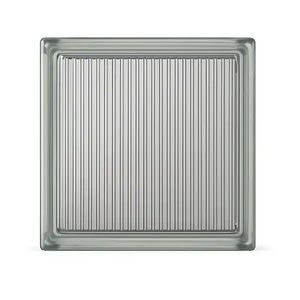
Glass block 30 x 30 x 8/10 cm made for the University of Deusto Library in Bilbao, designed together with architect Rafael Moneo.
Rafael Moneo approached Seves glassblock, the Glass block Division of Seves, in order to create his own glass block - a material capable of combining excellent construction properties with unprecedented aesthetic and formal potential - that would have become the characterising element of the project.
The surface of the Doric block -as the new glass block has been called- is enlivened by an interplay of grooves and reliefs that stick out about 20mm: it's the first time that a tridimensional decor in relief is created on the glass block surface. This innovation gives new possibilities to use this material in "sculptural" applications thanks to its charm to the touch and its preciousness to the eye, the complex reflections created and the effect of a moving and multi-faceted façade sought by the architect for his building.
Data of realizing the project: mid 2008
Architectural project: Arch. Rafael Moneo
Site: Bilbao (Spain)
Client: Deusto University, Bilbao |
|
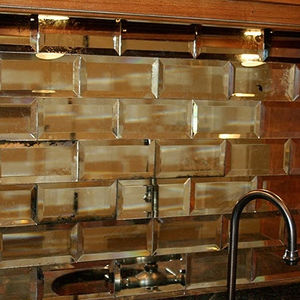
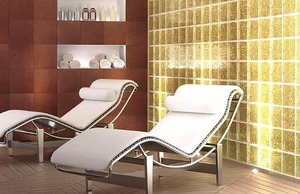
Golden brick is transparent glass combined with a polyamide, the main element that Brick embodies, as a new contemporary element to furnish and build walls, partitions or parts of walls and partitions, conferring modernity and design in addition to facilitating assembly.
Golden Brick is another exclusive evolution.
Glass with its transparency meets the nobility of gold, fusing technology and art in a Trend Up creation of great prestige.
Available in Trend Up showrooms. |
|
A "Zen" glass block, able of softening direct sunlight and at the same time of projecting magic shapes all around the space - a myriad of small Buddhas in prayer.
This is the latest innovation from Seves glassblock, world leader in glass block production, that provided 9,700 glass blocks for the new "Buddha Lecture Room", a religious library in Taichung (Taiwan) designed by the architect Daniel Tai. Currently in realisation, 1,800 pieces of the global glass block supply for the project have been personalised with an ad hoc design requested by the architect: the image of Buddha in a meditative position, sitting with crossed legs on a meadow of lotus flowers.
The design is imprinted on the glass surface in a second phase of processing of the block, after it has been baked in the kiln, using a special protective mask applied before dipping the block in a "bath" of frosting, with the final effect of interplays and contrasts of chiaroscuros between the opaque treated surface and the original transparent surface.
A fast procedure giving an amazing result, affording new decorative applications for the material, in tune with the specificities of each project request. In this context, in fact, the image applied becomes not only the aesthetic motif characterising the building, but externally it allows the immediate legibility of its religious function, obtaining an attenuated and evocative atmosphere inside, one that is propitious to reading and meditation.
Latest innovation coming out from the Seves glassblock Tailor-Made service, the decoration of the surface of the block is added to the numerous possibilities of personalisation available, starting from the simplest modifications of the glass colour, finishings and designs of catalogue products, to a full-blown formal experimentations, achieving unprecedented creations.
First result of this productive capacity was the special squared glass block with maxi format 42x42x12cm realized for Renzo Piano's Maison Hermes in Tokyo, which permitted the amazing visual effect of a continuous "all glass" façade for the first time, thanks to the combination of large dimensions and wings - the characteristic projecting external edging of the block .
The new 33x33x12cm square format comes about from the partial scale reduction of this element, accomplished so as to conserve its aesthetic characteristics while reducing its industrial costs: used for the first time in the library of Taichung, dimensionally it is halfway between the standard Q19 block and the Q42 block for Hermes, now in Seves glassblock' s catalogue available as the large format of Pegasus. |
|
"The greatest contribution to glass block architecture made in the world o date". Vetroarredo has brought a new quality standard to glass block production as a result of its involvement in Renzo Piano's project for the Maison Hermès in Tokyo. In fact, it is no coincidence that, in order to meet the challenge of building the Japanese Hermès venue, Renzo Piano - famous for his lightweight constructions and use of materials with creative simplicity - found in Vetroarredo a valid partner which was able to help him achieve his ambitious objective of creating a magic lantern to accommodate the Hermès "mega store": 13,000 glass blocks, 45 meters high, 11 floors, in the center of the Ginza district of Tokyo.
The only company in the world willing and able take up this difficult but exciting challenge, trusting in its ability to innovate production processes as well as the products themselves, Vetroarredo created a new experimental type of glass block for the Piano/Hermès project, with truly unique features: the Hermès block, with its extraordinary dimensions, 42.8 x 42.8 cm.
|
|
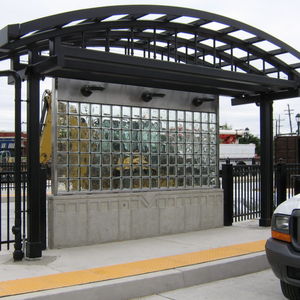
| Railway Station - Hannover (Hannover - Germany) - Arch. Frank Jorg Goritz |
|
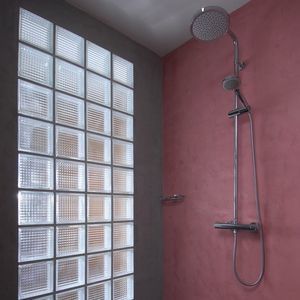
Design bright, spacious shower boxes with glass blocks and bring natural light into every aspect of your bathroom.
The Seves glassblock collection offers a series of glass block designs, patterns, and colors for varied levels of style and elegance.
|
|
The multi-coloured richness of precious stones- intense red of ruby, the delicate violet of tourmaline, the deep yellow of violet topaz (…) - combined with the brilliance and transparency of the glass block.
From the effervescent mind of Studio Mendini and the production capacity of Seves glassblock comes the “Mendini Collection”, a new collection of glass blocks inspired by nature and conceived to enliven contemporary domestic landscapes with new shades and visual sensations.
“With the Mendini Collection” - explain the designers. “the idea is to make a meticulously prepared, complete and joyful palette of coloured blocks available to architects and interior designers, (…) making the possibilities of its aesthetic and expressive language more sophisticated and ample".
Sixteen colour possibilities—from the most audacious and strong shades to blacks and whites in varying degrees of transparency—give life to a new generation of interior design elements in “lively” colours, thanks to special production technologies that maintain the absolute purity of the colour shades.
To showcase the new colours, the Pegasus glass block with wings was selected in the 19x19x8cm format with a smooth glass design and metallised finishing, characteristics that make the shades even more sharp, full and impactful.
Dimensions: 19x19x8 cm
Colours: White 100%, White 30%, Black 100%, Black 30%, Ametista, Malachite, Zaffiro, Citrino, Corallo, Agata, Tormalina, Giada, Rubino, Topazio, Ambra, Berillo.
Glass design: smooth
Finishing: metallised |
|
TECHNICAL FEATURES
The edges of the Pegasus block extend 6 mm at each side, 4 mm mor than conventional glass blocks.
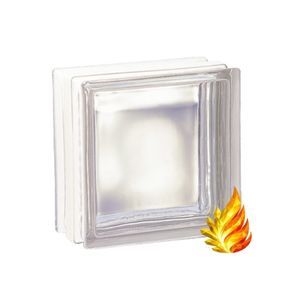
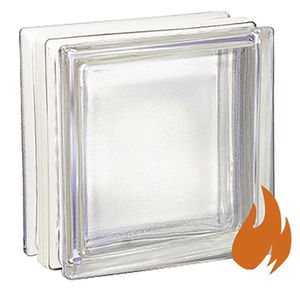
The overall dimensions of the glass block remain the same (190 x 190 x 80 mm) face dimension. The technical features of Pegasus block are unchanged with regard to their fire resistant (REI 15 and RE 60) and light transmission properties, whilst their performance in the following areas is improved:
- resistance to breakage
- resistance to compression
- thermal shock
- heat insulation
- sound-proofing |
|
TECHNICAL FEATURES
The edges of the Pegasus block extend 6 mm at each side, 4 mm mor than conventional glass blocks.
The overall dimensions of the glass block remain the same (190 x 190 x 80 mm) face dimension. The technical features of Pegasus block are unchanged with regard to their fire resistant (REI 15 and RE 60) and light transmission properties, whilst their performance in the following areas is improved:
- resistance to breakage
- resistance to compression
- thermal shock
- heat insulation
- sound-proofing |
|
TECHNICAL FEATURES
The edges of the Pegasus block extend 6 mm at each side, 4 mm mor than conventional glass blocks.
The overall dimensions of the glass block remain the same (190 x 190 x 80 mm) face dimension. The technical features of Pegasus block are unchanged with regard to their fire resistant (REI 15 and RE 60) and light transmission properties, whilst their performance in the following areas is improved:
- resistance to breakage
- resistance to compression
- thermal shock
- heat insulation
- sound-proofing |
|
PEGASUS. A HISTORY OF INNOVATION IN THE VETROARREDO TRADITION.
"The greatest contribution to glass block architecture made in the world o date". Vetroarredo has brought a new quality standard to glass block production as a result of its involvement in Renzo Piano's project for the Maison Hermès in Tokyo. In fact, it is no coincidence that, in order to meet the challenge of building the Japanese Hermès venue, Renzo Piano - famous for his lightweight constructions and use of materials with creative simplicity - found in Vetroarredo a valid partner which was able to help him achieve his ambitious objective of creating a magic lantern to accommodate the Hermès "mega store": 13,000 glass blocks, 45 meters high, 11 floors, in the center of the Ginza district of Tokyo.
The only company in the world willing and able take up this difficult but exciting challenge, trusting in its ability to innovate production processes as well as the products themselves, Vetroarredo created a new experimental type of glass block for the Piano/Hermès project, with truly unique features: the Hermès block, with its extraordinary dimensions, 42.8 x 42.8 cm.
The Hermès block is not only a tangible expression of the remarkable glassmaking production with which Vetroarredo has abundantly surpassed currenttechnological production limits, but also a symbol of architectural excellence. In fact, apart from its extraordinary dimensions, two additional solutions have been used for the Hermès block:
- more prominent edging, making it possible to improve the positioning ofadjacent blocks; the visual effect obtained means that the metallic supporting
structures are hidden, thus reducing the "gap" between the block s;
- metalicized painting of the sections marking the edges of the block: an elegant and sophisticated detail which accentuates the luminous reflection
of the Hermès building.
|
|
PEGASUS. A HISTORY OF INNOVATION IN THE VETROARREDO TRADITION.
“The greatest contribution to glass block architecture made in the world o date”. Vetroarredo has brought a new quality standard to glass block production as a result of its involvement in Renzo Piano’s project for the Maison Hermès in Tokyo. In fact, it is no coincidence that, in order to meet the challenge of building the Japanese Hermès venue, Renzo Piano – famous for his lightweight constructions and use of materials with creative simplicity – found in Vetroarredo a valid partner which was able to help him achieve his ambitious objective of creating a magic lantern to accommodate the Hermès “mega store”: 13,000 glass blocks, 45 meters high, 11 floors, in the center of the Ginza district of Tokyo.
The only company in the world willing and able take up this difficult but exciting challenge, trusting in its ability to innovate production processes as well as the products themselves, Vetroarredo created a new experimental type of glass block for the Piano/Hermès project, with truly unique features: the Hermès block, with its extraordinary dimensions, 42.8 x 42.8 cm.
The Hermès block is not only a tangible expression of the remarkable glassmaking production with which Vetroarredo has abundantly surpassed currenttechnological production limits, but also a symbol of architectural excellence. In fact, apart from its extraordinary dimensions, two additional solutions have been used for the Hermès block:
• more prominent edging, making it possible to improve the positioning ofadjacent blocks; the visual effect obtained means that the metallic supporting
structures are hidden, thus reducing the “gap” between the block s;
• metalicized painting of the sections marking the edges of the block: an elegant and sophisticated detail which accentuates the luminous reflection
of the Hermès building.
|
|
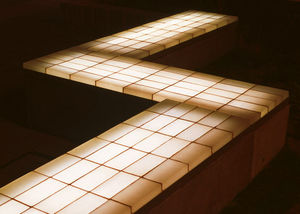
| Unleash your creativity with GlassOre glass bricks. With the weight and texture of a traditional masonry brick, GlassOre dramatically changes the appearance of a room when lit from behind or underneath. Ideally suited for artistic accents, GlassOre can be used in interior or exterior applications for a striking look. |
|
| This system is designed for use with 1-1/2" thick solid glass blocks. It is currently being made in nine-block panels with perimeter aluminum receptor frames which allow the panels to be installed or removed as units. The nine-block panels can be shipped to the jobsite glazed or unglazed. |
|
|
|