|
|
|
The two types of wall (bolted and berlinese) are built to retain soil from excavation, and possibly provide a sealing and foundations for a structure.
|
|
In this technique, parts of the retaining wall (soldier piles, cast-in-place or precast columns) taking the passive earth pressure (at the toe) and the active earth pressure (multiple tie-backs or struts) are built before excavation commences.
When these are in place, excavation proceeds in stages (one to a few metres deep, depending on the stand-up time of the soil). Struts or ground anchors are immediately installed on the soldiers previously built, and sheeting is placed against the exposed soil faces.
Several stages of excavation may be necessary (there are cases of six rows of tie-backs). The sheeting spanning between the soldiers may be made of precast concrete slabs, wood timbers, steel beams or shotcrete.
The generic name of Berlin wall comes from the fact that the technique has been widely used in that city. There, the soldiers were steel beams, usually installed in boreholes a few metres apart. The system was mostly used as a temporary support of excavations.
|
|
Berliner walls
Definition:
consistent wall of::
profiled vertical (piles or metal section)
wood shielding, prédalles or shotcrete
Characteristics:
only retained ground
only possible if the water level is lower than the level of earthwork
ground must have temporary cohesion to excavate and place the shielding.
without anchoring, displacement at the head considerable (plusieures cm) necessary pourque the passive resistance is formed.
possible ground excavation depending on the technique
Scope of application:
ground reserve (without sheet of water on the height of excavation
economic solution
|
|
The soldier pile wall is a temporary or permanent retaining wall commonly
used for excavations in urban areas.
The method consists of :
Drilling regularly spaced boreholes in which metal beams are sunk
Installing cladding (wood, shotcrete, steel plates) between the beams as the excavation
progresses
The stability of the retaining wall is temporarily provided by struts or anchors except in shallow
excavations where the wall may be self-supporting.
|
|
|
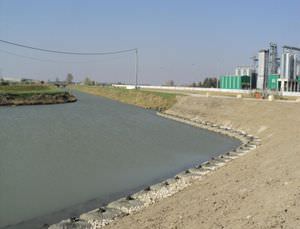
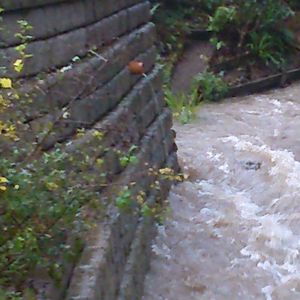
Enviroflex® is an articulating concreate erosion control block designed for use in riverine and channel environments. Applications include dam/spillway overflow protection, culvert outlets, detention / retention basics, embankments, wetland traffic crossings and applications where erosion, scour and maintaining environmentally responsible surroundings are of concer. Enviroflex® is manufactured in the USA from fiber reinforced concrete.
|
|
|
|
|
|
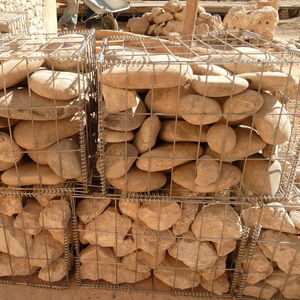
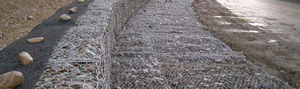
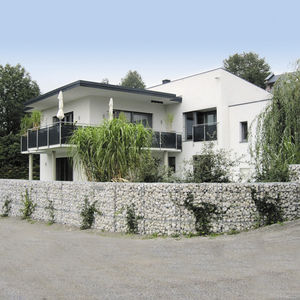
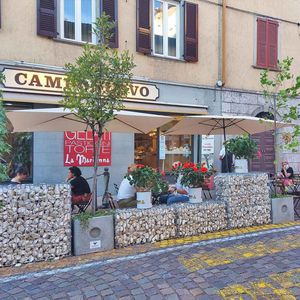
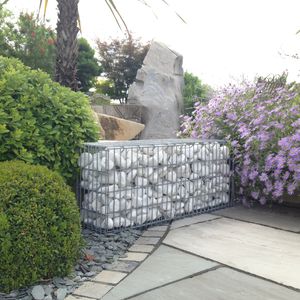
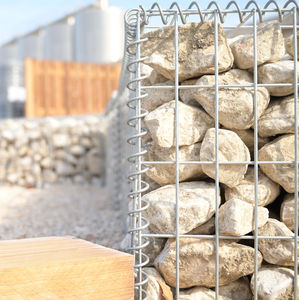
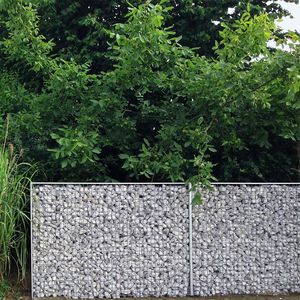
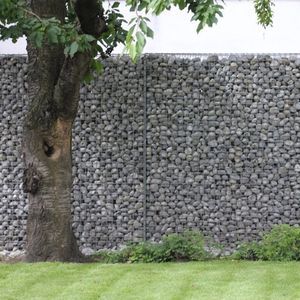
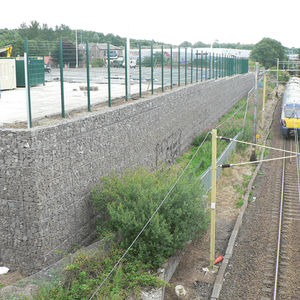
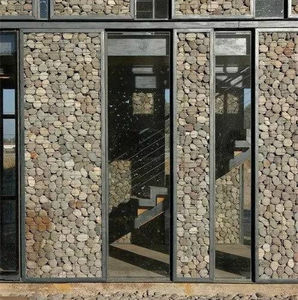
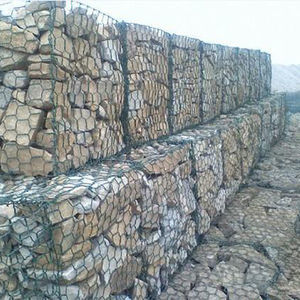
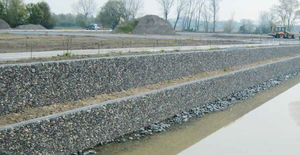
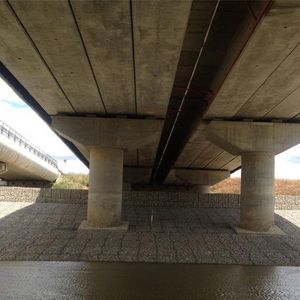
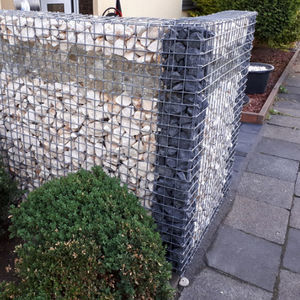
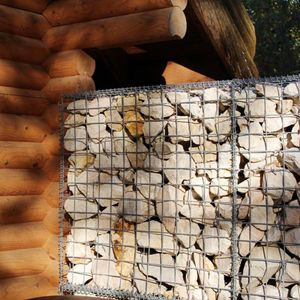
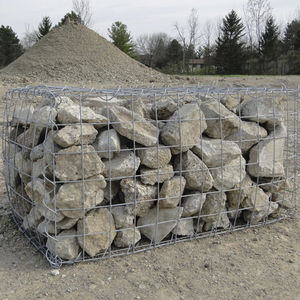
Process PANOGRIL CAISSON® allows the realization of retaining and screen walls out of boxes standard mineral filling "gabion".
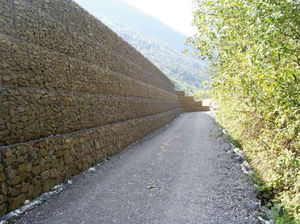
The works are gravity retaining walls consisted the superposition of box filled with stones for heights up to 6,0 Mr.
Beyond, the wall can be reinforced by technique RENFOTER® (reinforced ground).
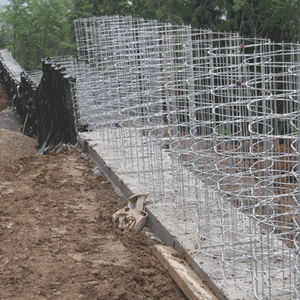
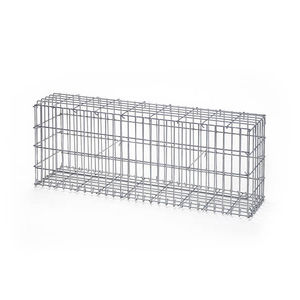
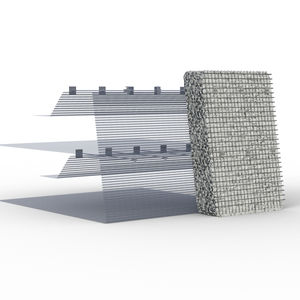
BOX PANOGRIL® is made up:
- panels out of steel fabric,
- interior elements of connection connecting and solidarizing the panels constitutive of the box,
It is filled by a granular material of features compatible with the use in gabions.
The facing can be vertical, tilted, with or without steps. The diameters and meshs of the panels are given to return the steel of the most discrete possible facing while conferring on the boxes a good rigidity for the implementation.
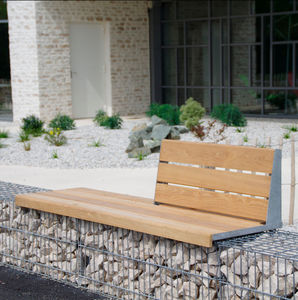
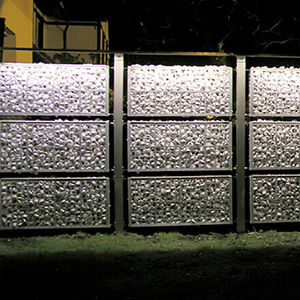
Dominate of employment: walls retaining in gravity retaining wall, screens, screens antibruits, pareblocs, anti-falls of blocks, traps with stones, walls staged, installations of banks, low walls landscape designers.
Advantages:
- Process very adaptable to the projects.
- Choice of dimensions of the fill boxes and materials, according to desired esthetics.
- Durability: the panels consist of bars with a mini diameter 4 mm, out of galvanized steel.
- Geometrical Stability during the mechanical filling.
- Simplicity of implementation, not of specific tools.
- The handling of all the elements can be manual.
- In the event of reinforced solid mass, the connection of the reinforcements to the boxes is easy and instantaneous.
|
|
The process COATING PANOGRIL® consists in equipping with the concrete walls reinforced by panels out of steel fabrics galvanized with a mineral filling.
The formed facing of panels out of steel fabric is fixed on the wall support out of concrete reinforced via crutches with connection.
Space between the wall support and the facing out of lattice, is 20 to 50 cm thickness, is filled of stones, rollers of features compatible with the use in gabions.
Field of application: coating by mineral filling (stones, rollers,...) walls reinforced concrete, buildings, walls of face, wing walls, curtains of piles, returned of type "gabions".
Advantages:
- Simplicity of implementation by the simplicity of fixings, the assembly and the filling
- Esthetics of the standard mineral facing "gabions" for walls concrete
|
|
Process FIBRATER® makes it possible to carry out retaining walls in gravity retaining wall, screens antibruit and coatings of walls starting from beams and cross-pieces out of wooden, intersected and solidarized by stems of connection.
The facing is consisted of the superposition of the cross-pieces and the beams of round or rectangular section with filling out of granular materials and possibility of filling partly with topsoil and vegetalisation.
Field of application: let us merlons antibruit, screens out of wooden, retaining walls, traps with stones.
Advantages
- Easy Assembly and rapid - Elements manutentionnable with the hand,
- Cordial Esthetics of the facing wood,
- Mechanical Filling,
- Acoustic Performances,
- Economic Process by the materials which composes it and the simplicity of implementation.
|
|
|
|
|
|
Reinforced soil slopes offer a fast, economical and versatile technique for constructing new embankments or repairing failures to existing slope structures. In fact, Tensartech slopes may be built at up to an angle of 70° beyond and Tensartech NaturalGreen are for structures built to 45°.
For GreenSlope structures beyond and up to Tensartech NaturalGreen 70° the system of choice is Tensartech GreenSlope.
Environmental constraints and rising land costs have increased the need for value engineering, frequently requiring the engineer to make use of cohesive or contaminated soils as fill materials. Both NaturalGreen and GreenSlope can take advantage of this by allowing the engineer to use these site won materials in the design.
Reinforced soil slopes provide an economic solution and give engineers the confidence to create structures with a natural vegetated finish.
Some of the benefits of Tensartech Slopes Systems are:
-Minimises land use
-Restricts encroachment into environmentally sensitive areas
-Reduces the amount of fill required for conventional slope angles
-May allow the use of site-won soils
-Simple and rapid construction
-Cost-effective alternative to conventional concrete retaining walls
-Vegetated face is a softer alternative to hard face retaining walls in sensitive areas
Systems include:
Tensartech Natural Green
Tensartech GreenSlope
Tensartech Slip Repairs
|
|
|
|
|
|
Process VIVATER® is intended for the realization of merlons antibruit, of coatings and retaining walls of walls végétalisables.
In supporting, the stability is ensured by the implementation of connected reinforcements of the facing (concept RENFOTER®), the concerning whole technique of the reinforcement of the grounds by not very extensible and flexible reinforcements (NF P 94220-0 and 2).
The facing consists of concrete studs and reinforced concrete flagstones.
These studs and flagstones constitute a basin of reserve for the topsoil.
A system of watering can be easily integrated along the flagstones.
The reinforcements are out of hot galvanized steel fabrics, of form and size adapted to each project.
Fields of application: Merlons antibruit symmetrical or dissymmetrical, vegetable wall, Walls out of cut, Walls staged, coating végétalisable.
Advantages
- Overall Flexibility of the facing, thanks to the independence of the components;
- Increased Security, thanks to a very good overlap enters the facing, the reinforcements and the technical embankment.
- Required of a concrete sole, always horizontal some is the slope of the facing.
- Choice of the geometrical configuration of the work: influence on the ground, slope of the facing.
|
|
Samer Walls are the perfect answer to aesthetical and economic problem. Very easy and very fast.
Samer Walls are a tridimensional structure made of prefabricated concrete elements who contains soil to get the necessary weigh to contain the land.
Is it possible to chose different kind and colour.
|
|
|
Commercial (132 lb) block with a wall inclination of .25:1 used for walls up to 60' high, and tested for high velocity streambank use. Since the block is intended to be butted up in high velocity flows, the rails are set back to allow for a convex curve. The Verdura® 40 block is typically used in the freeboard where full plantability is required.
|
|
|
Candura is a near vertical, plantable, segmental retaining wall system. Candura is ideal when used as a low landscaping wall defining areas of a patio and for increasing seating area. Like Verudura, Candura incorporates a positive Geosynthetic-block connection system as well as a high form capacity necessary for proper wall construction. The four part product system (block, capstone, cornerstone and stake) enables it to negotiate both radius’ and 90 degree corners and enables construction of stairs and seating surface at the wall crest.
|
|
|
Lightweight (22 lb) block available through our distributors. Rails on block are set back to allow for butted up 3' radius. Applications include edging, planter beds and small retaining walls (max 3')
|
|
|
Heavier (65 lb) block available through our distributors. Standard designs accommodate walls up to 8' high using Posi-Dura Reinforcement where required. Walls up to 22' can be engineered.
|
|
|
|
|
|
Process RENFOTER BLOC® allows the realization of retaining walls in solid mass reinforced facing in modular elements concrete.
It concerns the technique of the reinforcement of the grounds by not very extensible and flexible reinforcements (Standards NF P 94220-0 and 2) and of the recommendations and code of practice "the works out of earth reinforced".
This very economic process makes it possible to combine the advantages of a true technical wall, thanks to the perfect connection between reinforcements and blocks, with a great simplicity of implementation.
The wall is consisted of association:
- of a facing made up of superimposed blocks,
- of a solid mass of fill,
- reinforcements connected to the facing and narrowly overlapping in the embankment.
The facing is made of parallelepipedic blocks out of compressed concrete, of dimensions Lxlaxh standards = 100x50x50 cm-140 kg, to superimpose.
The reinforcements are out of hot galvanized steel fabrics, of size adapted to each project.
Fields of application: slightly inclined vertical retaining walls or, walls out of cut, walls staged, walls with weak radii of curvature
Advantages:
- Increased Security: true retaining wall thanks to a perfect overlap enters the blocks of the facing and the reinforcements of the embankment.
- Economy by its great simplicity and good rate of implementation and a current material filling, in the respect of the recommendations of Setra.
|
|
Definition:
reinforcement of the cut ground progressively of its excavation by the installation of passive bars. To prevent that the ground does not run out between the bars a facing generally made up one places of a treuillis and a shotcrete
Characteristics:
excavation in phases (1 with 1.5m excavation, installation of the nails, shotcrete, excavation 1 with 1.5m, installation of the nails, etc)
displacement minimal at the head of the wall is equal to 2promille height of the maximum excavation. Displacement is inevitable to introduce friction into the passive nails.
without vibrations
method calculated like wall of weight (standard "Clouterre")
Scope of application:
reinforcement of the existing taluds
realization of the higher and/or stiffer slopes
limited to the sites except ground water
unusable in grounds non-cohesive short-term
|
|
The nailed retaining wall is the archetype of light, flexible shoring combined with the terrain.
This shoring relies essentially on the stabilising capacity of the nails combined with a containment skin in shotcrete.
Excavation is performed in successive top down stages with immediate implementation of the nails and shotcrete.
|
|
Definition:
walls in piles either independent, or tangent, or secant.
The piles can be installed according to the techniques following:
piles independent: all techniques
piles tangent: CFA, GCV, GCV lambda, drilled piles of large diameter, piles double rotation
secant piles: drilled piles of large diameter, piles doubles rotation
Characteristics:
piles independent and tangent: only retained ground. Level of water must be lower than the level of excavation
secant piles: reserve of water and grounds
secant piles: traditionally only one pile out of two is armed (pious sécundaires)
considerable bearing load
no the horizontal reinforcement, it is necessary to envisage a beam of distribution
Scope of application:
when should be crossed obstacles (masoneries, rocks, concrete)
excavations of irregular size (walls in piles are more adaptable than slurry trench walls)
excavations of limited size.
cilindric rigidity in excavations circular limits the quantity of steel
|
|
PRECASTING OF PANELS
The panels are made of reinforced or prestressed concrete.
Precasting is done in an industrial process; manufacturing of heavy panels of 40 tonnes is commonly achieved.
Whenever possible, the precast factory is installed on the site. If this is not feasible, the panels are brought on trailers from an outside precasting yard.
|
|
|
|