


{{product.productLabel}} {{product.model}}
{{#if product.featureValues}}{{product.productPrice.formattedPrice}} {{#if product.productPrice.priceType === "PRICE_RANGE" }} - {{product.productPrice.formattedPriceMax}} {{/if}}
{{#each product.specData:i}}
{{name}}: {{value}}
{{#i!=(product.specData.length-1)}}
{{/end}}
{{/each}}
{{{product.idpText}}}
{{product.productLabel}} {{product.model}}
{{#if product.featureValues}}{{product.productPrice.formattedPrice}} {{#if product.productPrice.priceType === "PRICE_RANGE" }} - {{product.productPrice.formattedPriceMax}} {{/if}}
{{#each product.specData:i}}
{{name}}: {{value}}
{{#i!=(product.specData.length-1)}}
{{/end}}
{{/each}}
{{{product.idpText}}}
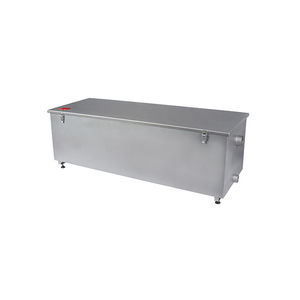

... litre unit, the trap prevent fats, oils and grease (FOG) and food debris from entering waste water, reducing the risk of pipe blockages which are not only disruptive but can also compromise hygiene and employee safety. The ...
ACO Building Drainage
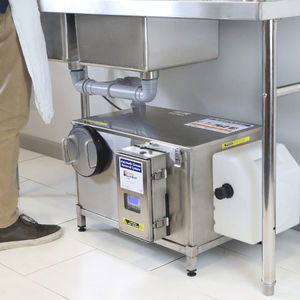

... Grease Separation Chamber Grease naturally rises to the surface, while clean water exits safely to the drain. 3. Liquids Heating Element The PLC-programmed heating element liquefies fats, oils and grease. 4. Grease ...
FME
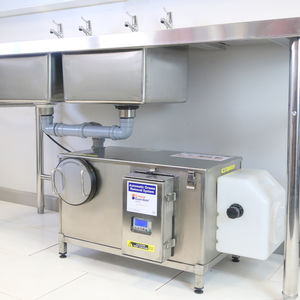
... aiming to safeguard internal plumbing from grease build-up. GGX Grease Traps with inbuilt Grease Removal Mechanism for automatically extracting captured fats, oils and greases. ...
FME
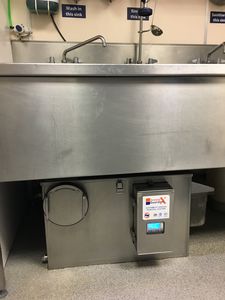
... 2. Grease Separation Chamber Grease naturally rises to the surface, while clean water exits safely to the drain. 3. Liquids Heating Element The PLC-programmed heating element liquefies fats, oils and grease. 4. ...
FME
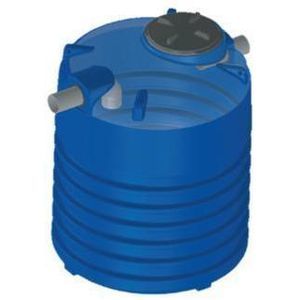

... Total volume: 500 L — Sludge trap: 100 L — Grease retention: 40 L — External: Ø1200 mm × H905 mm — Inlet/outlet: DN110 — SKU: A13.
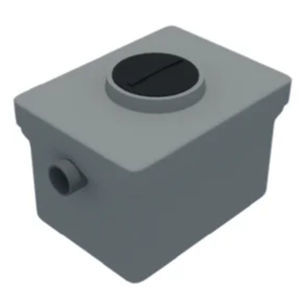
... Short description
ISGP plastic
grease separators are compact units designed to separate and retain vegetable and animal fats and oils from kitchen wastewater. Their polymer construction is inert to fats and oils and makes them ...
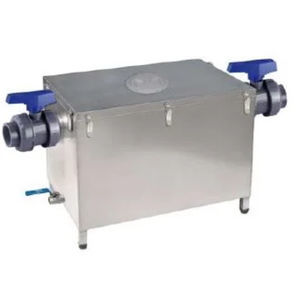
... Stainless steel grease separators are equipment that facilitate the separation and removal of vegetable and animal fats generated in a kitchen, preventing them from entering the downstream drainage system. They separate water from grease ...
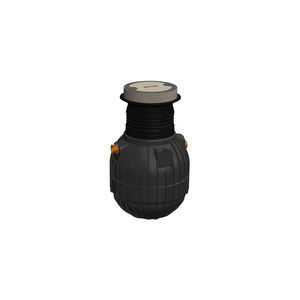

... consists of a precipitation area, a grease collector, a sludge trap and a sampling point. The system reduces the flow rate of the wastewater to allow solids – such as food leftovers – to sink and settle in the sludge ...
GRAF International


... footprint Mobile use (food-truck, mobile dishwasher...) Lightweight: 4 kg Must be emptied daily This space-saving grease trap can be installed under a professional sink. Moreover, it can be used for mobile ...
SFA Group
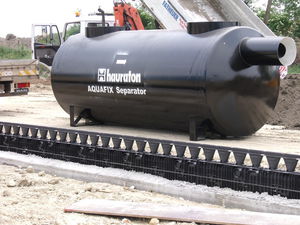

... Steel coalescence separators for the pretreatment of petroleum and readily settling suspended solids. Our solutions – your benefits – steel oil/water separators integrated in AQUAFIX settling tanks High-capacity steel separators are most often used ...
HAURATON
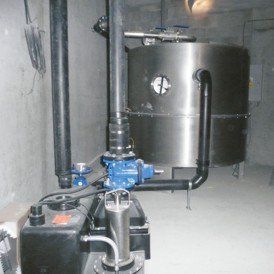

... A device that is steadily growing in popularity is the automatic grease trap. It is a mechanical grease trap consisting of a plastic or stainless-steel waterproof tank with a system of ...
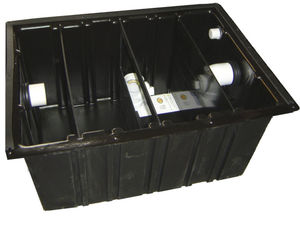

... the FOGHog® retains floatable substances, including: fats, oils, grease, soaps (lanolin) and waxes. These FOGHog® (Fats, Oils, and Grease) grease traps are lightweight,durable, and ...
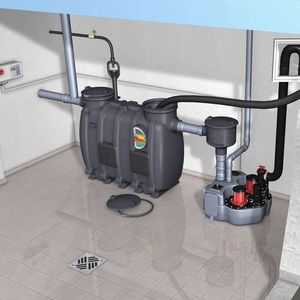

... stands for grease separator basic version. The version corresponds to the requirements according to EN 1825. The odour-tight domed covers of the grease separator have to be opened for emptying and cleaning. Extraction ...
KESSEL
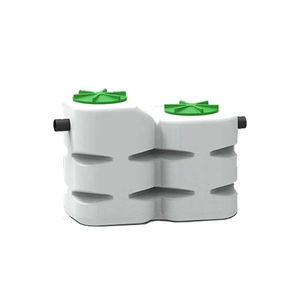

... RoMast grease separators are free-standing grease traps that can be installed in an existing building (basement, pantry). ...


... The DELHO GT-M grease trap is of the “manual under sink” type. It can be installed directly at the outlet of sink, oven, or on the cooking waste water pipe. As it is very compact and with a very simple design, it can ...
DELHO
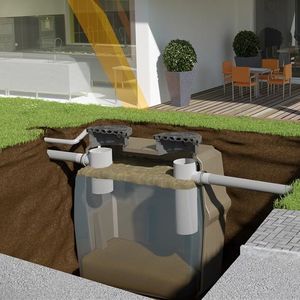

... PROCESS Greastop® is a grease trap that can be installed at the intake of a standalone treatment system or before the discharge into a municipal collection network. Greastop® grease trap ...
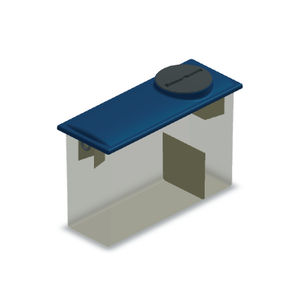

... supplemented by an Epers Durability: materials inert to grease Pretreatment apparatus intended to retain and accumulate plant or animal fat contained in household water. Sluge trap/ grease interceptor ...
Saint Dizier Environnement
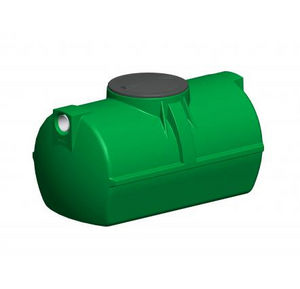

the best suppliers